
Repair shops grapple with changes in new vehicles
Trending
FAIRMONT - As cars change and evolve, repair shops continue to learn and adjust to how cars are designed and constructed in the modern day.
Car Pro Auto Repair Owner Jamie Johnson said he has been working on cars as long as he can remember, but didn't really get into the full auto repair side until he opened his business in 2008.
"There was a lot less than what it is now," he said. "A lot more limited. The diagnostic equipment was basically just a code reader that read the codes that were in there."
Back in the late 90s and early 2000s, Johnson said there was still a good amount of technology in cars at that point. While the cars were still mostly mechanical, he said they were just starting to add more electronics. Since then, he said it has ballooned.
"Late 90s, early 2000s, there were very few modules per se," he said. "It was just your main ECM engine computer, which was the brains of the car. Now you got multiple modules: engine control, body control, electronic brake control, airbags. Everything's got a module now, and then they all need to communicate together."
While the technology inside the cars has continued to advance and allow drivers more options, Johnson said this has led to fewer options for people to replace and customize certain options, like the dash.
"A lot of the newer cars they have about as much as you need for upgrades, really," he said. "It’s just so hard to customize and upgrade like you used to. Some of these have a 10-inch screen on them, almost like a laptop monitor on the screen. A lot of the newer cars, you’re not seeing a whole lot of options to update unless it’s a manufacturer’s system."
Johnson said more of the modern vehicle's components and overall composition of the car are electronic, but mechanical parts are still a crucial part of the process.
"You still have your mechanical side," he said. "You still have your motor and your transmission on the majority of the vehicles. There are electric vehicles, which are all electronic. There is still some mechanical side to it. You have your hybrid vehicles, which are part hybrid, lots of electronics, little bit less mechanical. There’s a lot more electronics on the other side of it that need to work properly for the mechanics to work."
Speaking to that necessity on electronics, Johnson said now it is like a network of components they have to check to track down the problem.
"If one part of that network goes down, then it can shut down all the other components," he said. "Say, for instance, your speedometer stops working, your air conditioning stops working, your windows stop working, and it could all be related to your airbag module in the seat. It’s a lot of tracing the network. We run into a lot of that. We see a lot of components that don’t work because something on the network is down or bad."
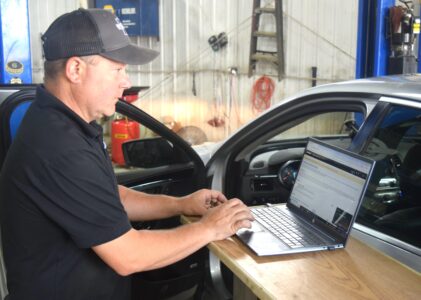
With the implementation of new technology, Johnson said it allows them to have more information and diagnose problems more easily.
"It gives you more data, so then you can research the data and pinpoint the problem a lot easier," he said. "Back in the day, it was more experience, and based off of, 'Oh, that sound, that sound refers to this.' Now you can put the computer in and read the data, and as long as you can analyze the data properly and know what you’re looking at, you can diagnose."
Even so, Johnson said the evolving technology in cars has made being an auto mechanic tougher.
"Bigger learning curve," he said. "Gotta stay ahead of the curve. Lots of training, lots of learning, lots of research, More diagnostic tools, more expensive diagnostic tools, higher-end equipment. It has changed the way of diagnostic for a vehicle compared to what it was back then."
To do so, Johnson said they are continuously looking at and doing training.
"We have different training outlets where we either go to on-site training or we have live online training that we do to learn the different technologies," he said. "Eight to 10 hours a month, maybe more depending on what’s offered, because the trainings are usually three nights a week, two hours a session, so six hours a week, and the guys usually do one session a month."
With this and the multiple up-to-date diagnostic pieces and scanners required, Johnson said they try to keep their costs as minimal as possible.
"Unfortunately, with rising costs, it has to be passed on through our pricing and potentially trickle down to the customer," he said. "We try to find the most inexpensive elements possible. We have several different outlets and vendors that we deal with and try to keep the cost down, so we can keep the cost down for our customers, but like everything, it’s all getting more expensive."
As the next ideas are put into action by car manufacturers, and older models are seen less and less with the passage of time, Johnson said he and his technicians at Car Pro Auto Repair are committed to continuing training and research so they can prepare for every vehicle that comes through their doors.