
Sylvania closed following discovery of remains
“Some unanswered questions at this time are exactly how old are those bones and are they of Native American descent.” — Police Chief, Mike Beletti
Trending
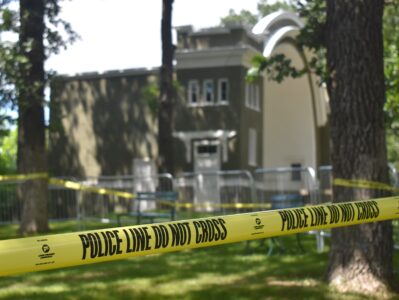
FAIRMONT-- A portion of Sylvania Park in Fairmont has been closed to the public following the findings of significantly decayed human remains on the southwest portion of the park.
"It's definitely unique," said Fairmont Police Chief, Mike Beletti, who provided a rundown of recent events.
"We got the initial call on the 7th, (Tuesday) night. A citizen was walking through Sylvania Park and found what they thought was a stick, so they pulled on it and it was a fairly large bone," Beletti said.
He added that the fact that the artifact was first believed to be a stick shows how decayed the bone was.
"They found some teeth as well so our officers recovered those on Monday night and we consulted with the Ramsey County Medical Examiner's Office, who obviously wanted to view that to see whether it was an animal or human remains," Beletti said.
The items were transported up on Tuesday, July 8 and initial observations led the office to believe they were human, but later in the day, after several doctors had reviewed them, they were confirmed to be human remains.
"Some unanswered questions at this time are exactly how old are those bones and are they of Native American descent," Beletti said. "That's going to require some experts, anthropologists for example, will have to look and examine them."
Once they found out the remains were human, Beletti said he contacted the Minnesota Bureau of Criminal Apprehension (BCA) for guidance and spoke with an agent who has experience with similar cases that potentially have a Native American background and instances of an unrecorded burial ground or cemetery.
Speaking to why the bones were believed to have come from a Native American, Beletti said, "we know from the history in Fairmont that Sylvania Park was a land that Native Americans lived on a long time ago."
He also said that when officers first arrived at the scene, they found a non-bone piece, described as a flint or smooth, ground-down rock, maybe an old tool, that could be considered a grave good.
Lenny Tvedten, the Executive Director of the Martin County Historical Society, confirmed that Native Americans have been associated with Sylvania Park. In fact, Sisseton Lake, which Sylvania Park sits on, was named for the Sisseton Sioux, a tribe of Dakota Native Americans who had villages in the area as late as 1860.
Both Beletti and Tvedten referenced an article Tvedten had written in November 2009 titled "The Legend of the Sisseton Oak," which referenced an article in the April 12, 1985 edition of the Martin County Sentinel titled "Tradition of The Sisseton Singer" and "Legend of the Sisseton Oak" by Major Arthur M. Nelson.
Tvedten summarized it saying, "there was a young, white girl that was captured by the Sisseton Sioux and lived with them and they got some sort of disease and blamed it on her and one of the Native Americans, called the Sisseton Singer, befriended her and long story short, supposedly they tied them to a tree and burned them alive."
That article says that the remains of the two victims were gathered and buried in the sand near the water's edge of Sylvania Park.
In moving forward after the initial findings came in, Beletti said they first had to determine if they were looking at a crime scene or an ancient burial ground.
"All indications to this point are that it's ancient. I'm not saying there's many bodies buried here, but there's at least one is what we think at this point," Beletti said.
The BCA had suggested, knowing that it's likely Native American-related, that the Minnesota Indian Affairs Council also be contacted.
On July 8, that group was contacted and interested and after doing some initial research, ended up coming to the area of the park on July 9.
"The park remains closed because they need to consult with some other experts and conduct further research on the site itself," Beletti explained.
He said he believes it could be several months yet before it's determined what they're dealing with. One thing, however, he could say is that there is no threat to public safety and that they are not dealing with fresh remains.
"This is more than likely, not a criminal matter at this point," Beletti said, adding, "and we don't have any unsolved homicides, with no body, in our area."
He also said that early estimates would be that the remains are well over 100 years old.
Beletti acknowledged that the area of the park is highly traveled and that the remains have been there for a long time without anyone seemingly noticing them.
Speaking to what he thinks could have brought the bone to the surface now, Beletti said, "I do think that that area has eroded over time. There's a curve along that portion of the park. It's on the corner that faces the lake. There's dirt built up on that curve so clearly water has rushed down there from the park and eroded that path over time," Beletti said.
It's expected that a portion of Sylvania Park will remain closed for the foreseeable future and the Fairmont Police Department asks that the public remain respectful as various department work to assess the site.