
Sheriff’s office ensures safety on water
Trending
FAIRMONT-- With a holiday weekend upon us, and an expected increase in watercraft traffic, the Martin County Sheriff's Office will be diligent in observing activity on the Fairmont Chain of Lakes.
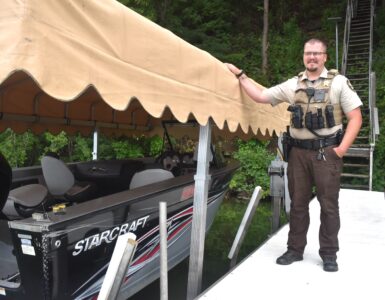
Minnesota State Statute dictates that the water is patrolled and enforced by the local county sheriff's office. The Martin County Sheriff's Office therefore has a boat that's docked behind the courthouse and its adjoining office on Lake Sisseton in Fairmont.
Colin Meadows, a deputy sheriff, is currently overseeing boat and water activity.
"Generally the boat is put in early June. We use a Jon boat to put out all the buoys on the lakes," he explained.
As for when the boat comes off the water, Meadows said it varies on the season but it's usually end of August or early September.
Speaking to what their general goal is on the water, Meadows said, "It's more or less to promote safe boating, make sure there are no accidents or no impaired boaters out there. We just want everyone safe on the waters."
He said it varies as to what they look out for but some of the things include making sure there are enough life jackets for boat occupants and watching for wakes at times there is a no wake ordinance in place.
"Just general boater safety, making sure they're safe," Meadows said.
Children 10 and under are required to wear a life jacket when the watercraft is underway, unless they're in an enclosed cabin which Meadows said isn't common around here.
A new change this year is, beginning July 1, 2026, anyone 12 or older, or those born after June 30, 2000, must have a watercraft operator's permit to drive most motorboats and personal watercraft, like jetskis. This is part of a law that went into effect in 2025.
Meadows stressed that it is a tiered rollout. In 2027, anyone born after June 30, 1996 is going to be required to have an operator's permit and in 2028, anyone born after June 30, 1987 is going to be required to have an operator's permit.
"It's going to be a learning curve but at least it's not everyone born after 1987 needs one this time. They're giving you time to work things out," Meadows said.
Speaking of jetskis and the increase of their presence on the water, Meadows shared some guidelines.
Personal watercraft like jetskis, per state statute, cannot travel between the hours of one hour after sunset and 9:30 a.m. and cannot travel at a speed no faster than "slow no wake" within 150 feet of a shoreline, dock, swimmer or raft used for swimming or diving. A jetski can also not tow a person on skis, kneeboard or inflatable craft unless they have an observer with them.
While boats in general do not have that 150 ft. rule to them, Meadows said that the Minnesota Department of Natural Resources (DNR) suggest that boats try not to create a wake within 200 ft. of shoreline but that there's an actual state statute for personal watercraft on where they can't make wake.
He had some other information to share to help keep everyone safe on the waters.
"With Fourth of July coming up, I know a lot of boats are out there after dark so make sure you have your lights on at night while watching the firerworks," Meadows said.
He also suggested boat operators work hard to get their watercraft in and out of the water as quickly and safely as possible while using the public boat ramps, which he acknowledged can get congested over weekend use.
Finally, he stressed the importance of sober driving.
"What I would suggest for everyone is to have someone sober driving the boat. Driving the boat impaired and driving a motor vehicle impaired is the same thing."
The DNR and other public safety agencies are targeting intoxicated boaters July 3-5 as part of Operation Dry Water, a national campaign aimed at deterring boating under the influence of drugs and alcohol.
A press release from the DNR said "the goal of operation Dry Water is to reduce the number of BWI-related boating accidents and fatalities. Shared waterways mean shared responsibility and it's up to every boater to make sure they're keeping themselves, passengers and others safe."
While Meadows said typically the boat in the water officers set their own hours for when they'll be on the water, he expects they'll have an increased presence over the holiday weekend.
"It sounds like for the Fourth of July, they'll be out all day and night until the fireworks are over," Meadows said.
In general he said if something is called in while a designated boat in water officer is not working, everyone at the sheriff's office knows how to operate the boat and knows boating statutes so they can handle it.