
High school’s debut class celebrates 50th
Trending
FAIRMONT-- The Fairmont High School class of 1973 is holding its 50 year reunion this weekend. Most notably, the class was the first to graduate from the existing high school building.
The class, which many could say shares a special bond, has been having class reunions every five years. This weekend's reunion, its golden reunion, is thought to be the biggest yet. It's being organized in part by two students, Barb (Dvorak) Iverson and Cheryl (Nolte) Youngblood.
The two reflected back on the events leading up to their unusual high school school years and their graduation in 1973.
In September of 1969, after two attempts, the junior high school building, which was located where Veterans Park is now, succumbed to a fire set by a student. The school building had been built in 1915.
The fire left roughly 700 students displaced. The class of 1973 were freshmen.
Iverson pointed out that at that time, there were three grade schools: Budd, Lincoln and Central, plus St. Paul's Lutheran and St. John Vianney. All of these students in 7th grade began attending the junior high, which housed students in 7th through 9th grade.
After the fire, those 700 students spent maybe two weeks without going to school as the matter of where and when they would go to school was considered.
Youngblood noted that at that time, all of the class sizes were large because they were the generation of the baby boomers. The class of 1973 alone had 251 students.
"There wasn't a whole lot of extra space in Fairmont to accommodate that. What do you do with the kids, the educators, the resources? What do you feed them? It was a whole shift for the entire community," Youngblood said.
A solution was come up with pretty quickly. The students began attending what's now Fairmont Elementary School, though at the time it was the senior high school.
However, the senior high students still occupied the space and had classes to attend as well, so with an additional 700 students, plus educators, coming in, space was limited. As a result, all of the students began taking classes on a "split shift."
While the internet was founded in 1969, Youngblood pointed out that it wasn't available to rural America at the time and that the concept of distance learning was never a thought or an option.
Thus the split shift had senior high students attending classes from 7:15 a.m. to 12:15 p.m. and junior high students going from 1 to 6 p.m. Each group got a 20 minute break, mid-morning and mid-afternoon, where it was provided with a cold sandwich, but never a hot meal.
There still weren't enough rooms, so six classrooms were used at Grace Lutheran Church, which was fairly close.
"They also built quonset huts that they made into classrooms. When you walked they kind of vibrated," Iverson said with a laugh.
Youngblood said that activities like choir, theater, band and sports were done either early in the morning, before classes started, or late in the evening after the junior high students were done. She noted that neighbors would drive students to school or practice at non-traditional hours because their parents were working.
Despite all of this, Iverson and Youngblood marveled at how everyone pulled together to come up with a solution, even if it wasn't convenient.
"It was pretty amazing what our educators and our community and our families did to give us a quality education, it really was," Youngblood said. "We learned how to pivot and how to be resilient. We didn't have time to feel sorry for ourselves."
"We didn't have a choice," Iverson added.
However, both agreed that they knew the class was in it together, which helped many form a close bond that still remains today.
After three years of going to school on a split shift, the class of 1973, along with the three classes below it, started the 1972-1973 school year in the new senior high school building, located on Johnson Street in Fairmont.
However, while they were supposed to start in late August, a construction strike-lockout delayed the project and thus the start of the school year by about two weeks. Classes started on Sept. 11.
Students had a mix of reactions to the new school building.
"It was a totally different concept from the building that burned and the building that we spent three years in," Iverson said.
Notably different in the new building was the absence of windows, which the other two school buildings the students attended had had.
"I thought it was cool. All of the buildings in Fairmont were old. This was the first massive campus. Everything was state-of-the-art," Youngblood said.
She specifically spoke about the Performing Arts Center at the high school and how it had ample seating, an orchestra pit and updated lighting.
"We were able to do so many more things because we had those resources. The community could use it, too," said Youngblood.
As for the cost of the new high school building, a Sentinel article from the time says, "Voters approved a $3.9 million bond issue to help finance the school and taxpayers started paying off the bonds last year. Payments will vary between $300,000 and $400,000 a year until the bonds are retired in 1991."
The total cost of the new building was $6 million.
Unfortunately, a few months into the first year at the new high school, there was a fire at the school. A Sentinel article says, in part, "High School Principal C.H. Hegdal... said some students had been seen in the area just prior to the fire. In recent months, the high school had been plagued with problems of student smoking... Some students had also requested that a student smoking lounge be built. Hegdal said there was no evidence that the fire was connected to student smokers."
While it was never discovered what or who caused the fire, many students were upset about it.
"The majority of the kids in school were mad. They brought us all into the gym for a lyceum and our class present got up and said, 'we can't let this happen... please think about this.' It was traumatic," Iverson said.
The class made its way throughout the rest of the school year. Right at the tail end of their time in school, many students were impacted when the legal drinking age changed from 21 to 18 on June 1, 1973. Two days later, on June 3, the class of 1973 graduated.
To celebrate, the class had a party at "The Hills," which is now Cedar Creek Park. A Sentinel article from that time says, "Fairmont seniors were praised by police today for the manner in which they conducted a "graduation party." The party, staged in Cedar Creek Nature Preserve, included serving beer. 'The kids policed themselves,' Police Chief Victor Hillmer said.'"
Iverson read part of a June 4, 1973 Sentinel article, which says, "The first class to graduate from the new Fairmont High School. The first to depart in many years during a time of peace without the prospect of a draft, military service or a war."
Since graduating 50 years ago, the class has held reunions every five years, though this year's is the biggest. Different class members have played a hand in planning the reunions over the years.
While many classmates are local, some have traveled from the Twin Cities, Idaho, Arizona, Iowa, Wisconsin and South Dakota to attend the reunions.
On Thursday night, the reunion kicked off when more than 70 students of the class of 1973 gathered at Fairmont Brewing Company. The local brewery even released a special Lager, titled "The Hills" in honor of the class and its reunion. Golding hops, from 1973 graduate Gene Tonne, were used in honor of the class's golden anniversary.
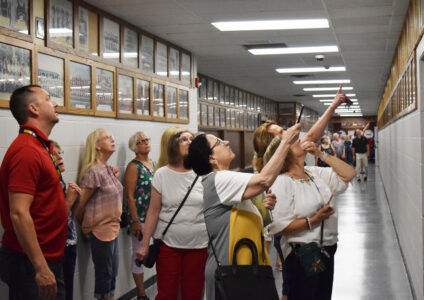
On Friday, a golf outing at Interlaken Golf Course, tours of the school buildings and a night at the Channel Inn took place.
The tour of Fairmont High School was led by current building principal, Chad Brusky, who spoke about some of the changes that have taken place in the building over the last 50 years. Brusky noted that up until last year, the common area had the same furniture that came with the original school building, making it 50 years old.
The class will gather tonight at Best Western for a banquet, which more than 100 people sent in an RSVP for.
Iverson shared why she thinks it's important to continue to hold reunions.
"We've lost 31 classmates and 14 since the last class reunion. That's why I continue to do this. I think it's important," she said.
"Our class, because we went to the split shift together, had a unique bond. We took this journey together that bonds you because it's not like any other journey. Even if we don't see each other for 10 years, there's this connection," Youngblood said.