FHS robotics teams rev up
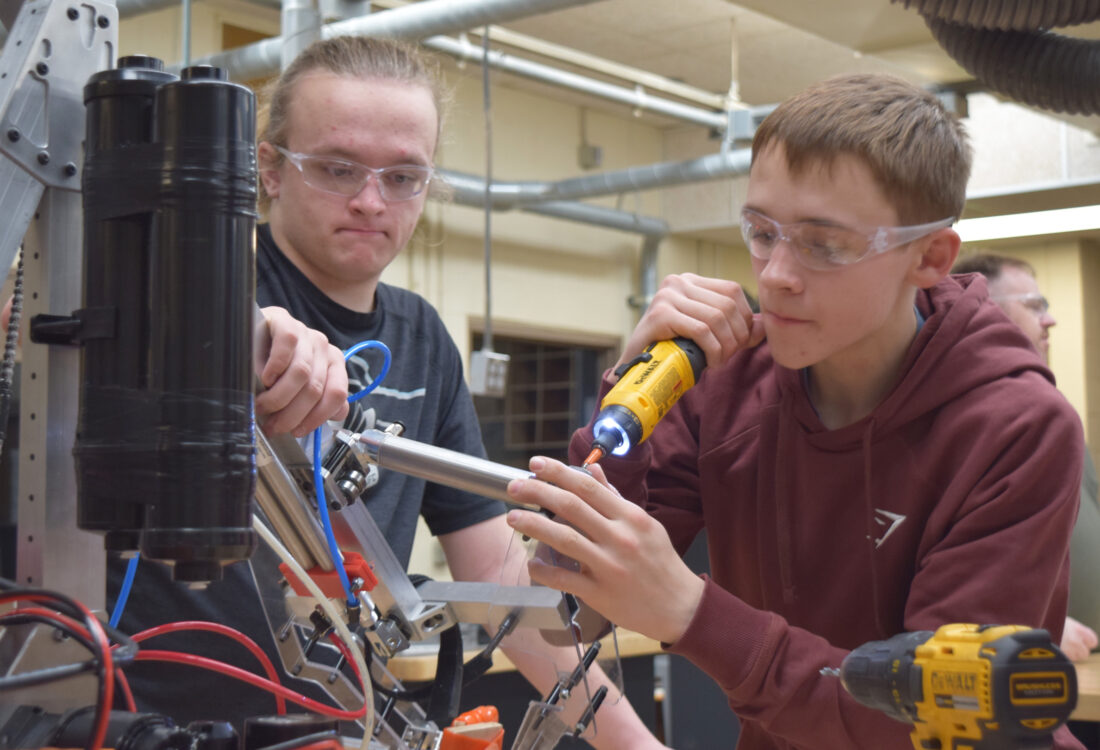
ABOVE: Fairmont Robotics members Aiden Nelson and Ty Nawrocki work on adjusting a robotic arm during a practice at Fairmont High School. The team is currently working on refining their robot ahead of a regional tournament in early March.
FAIRMONT– The robotics program at Fairmont High School has kicked off its season and teams are in the process of refining their robots ahead of competitions. This year the school’s junior high robotics team has returned for the first time since the beginning of the COVID-19 pandemic while the high school team is aiming to make it to the national competition after narrowly missing out last year.
This year’s junior high team, which consists of 12 students, is coached by Celia Simpson, an Americorp volunteer and Fairmont graduate who herself was a member of the high school team from 2014-2018. The 11 person junior high team began meeting on Jan. 26. The younger team builds robots which use a simpler programming interface and are smaller than their counterparts on the high school team.
During most years the junior high robotics season runs from October through December with competitions in January and February, but because the team restarted later in the year it will only have one in-house competition on April 1. The competition will use materials and rules from last year’s challenge which involved moving mobile goals around a playing field to collect discs.
Last year the high school team achieved its highest ever placement at the Northern Lights Regional Competition in Duluth, placing fourth out of 53 teams but not qualifying for the robotics world competition due to the pandemic reducing the amount of teams which were admitted.
Th is year the season began in November after fall sports wrapped up. The 19-member team began holding training sessions for new members and began to seriously ramp up in early January when this year’s challenge was revealed. Members of the team gathered to watch the announcement livestream before immediately jumping into a six hour design session.
“It’s really exciting because everyone’s waiting to figure out what the next couple months of your life are going to be like,” said said Sam Viesselman, a lead mentor for the high school team.
Since then the team has built a full-scale prototype which has been tested, dismantled and incorporated into the team’s current robot. The team is currently in the process of refining their design and addressing any flaws ahead of the competition.
In addition to teaching students different aspects of science and engineering, members of the team have said they’ve also learned valuable interpersonal skills.
Amanda Poetter is the team’s business lead and also works on the robot’s build team.
“I joined last year and it’s honestly become a second family. You really get to connect to everyone … and you really get to know everyone a lot better and we have such a good combination of people, people you’d never expect to mingle together,” said Poetter.
“The first and foremost thing (organizers) promote is teamwork, not even just in your teams but at competitions. If something breaks down you’ll have a bunch of people come and they’ll help you because you’re matched up with anyone in a match so your opponent could be your teammate next round so you always want them to be as good as they can be,” said Aiden Nelson, the team’s design lead and one of the robot’s operators.
This year’s high school challenge requires students to build a robot which can pick up and move traffic cones and boxes onto raised scoring areas in addition to being able to balance on a moving platform.
“This year the robot has to reach about three feet outside of itself to score the most points which is the furthest they’ve had us reach in a game for many years. The other competing constraint is there’s lots of benefits to being a small robot so we’re trying to figure out how to reach out three feet while also staying small and light,” said Viesselman.
The current iteration of the team’s robot consists of a pinching arm mounted on a support structure which moves on a wheeled drive base. The robot is primarily made out of aluminum but also incorporates parts that are made from steel, plastic and plywood. One notable feature of the robot is a pneumatic system which allows its arm to extend to up to five feet in length.
“This is definitely the smallest robot and the most ambitious that we’ve ever built. Last year’s success has really fired us all up,” said Nelson.
This year the team is based out of the former woodshop at Fairmont High School. The woodworking classes were moved into the school’s new vocational center and the former space is in the process of being turned into a STEM and robotics lab where students will learn how to work with new technologies. While no classes have been held in the facility, which is still undergoing renovations, the expanded space has already been a boon for the robotics team, giving it more space to work and test its robot.
“Last year we were confined to half a classroom and this has definitely been a game changer,” said Poetter.
In the first week of March the team will compete in the Northern Lights Regional event in Duluth from March 1 to March 4.
Local News
Weed removal business helps local find the right path

Coffee Lovers meet Thursdays at Lake Belt
Planning coming to fruition for IHD
FAIRMONT – After a year of planning, decision-making and setup, Interlaken Heritage Days (IHD) is fleshed out and ...

Old Alley Quilt Shop reflects on support as it prepares to close
Ceylon hosts town meeting, hears resident concerns
CEYLON — The Ceylon City Council had a special town meeting on Tuesday evening at the Mondale Park shelter house. ...