Fairmont High School debate team sees growth
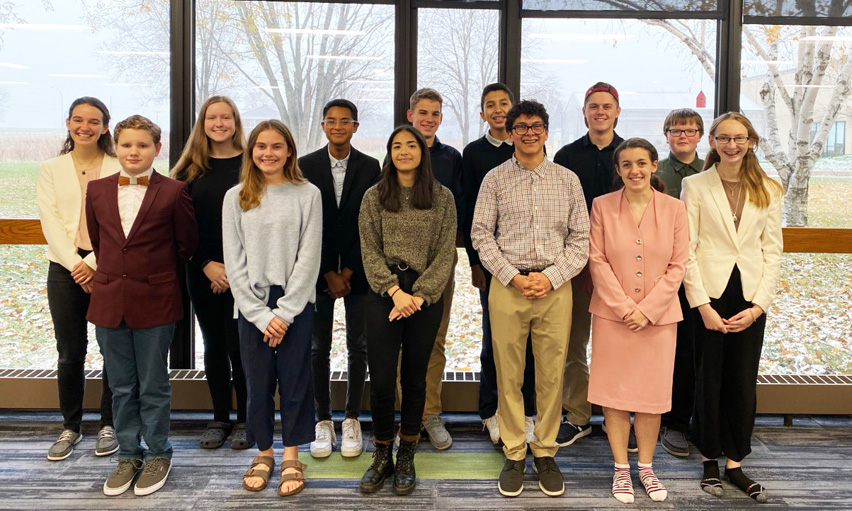
Members of the Above: Fairmont High School debate team pictured after a tournament. Back row, from left: Eleanor Hamlet, Kelsey Hunter, Selvin Forsyth, Thomas Hamlet, Dominic Lund-May, Isaiah Lockwood, Levi Loughmiller. Front row, from left: Clark Hazard, Season Kotewa, Andrea Rojo, Andrew Haefner, Kaycie Brookens, Kaylee Nelson.
FAIRMONT– Fairmont High School’s debate team has seen a steady increase in numbers since it was revived in 2017. This year the team had a new coach join as well.
Erik Walker, an IT specialist for the district, is co-coach of the debate team, as well as the speech team.
He said the team has been growing little by little each year and this year saw a bit of a spike in numbers. The Minnesota State High School League activity is open to students grades 7 through 12.
“Back in the beginning we had four and then dropped down to two. Last year we had about eight and this year we have 14,” Walker said of team members.
He said 14 might not sound like a lot if you’re thinking about numbers for a football or basketball team, but for a debate team it’s a good number.
The team also grew with the addition of co-coach, Christine Barkley. Barkley is a local law clerk who moved to the area in September.
The two met and found out they had both gone to the same high school, Henry Sibley, now Two Rivers, and were both on the debate team there. Walker graduated in 2009 and Barkley in 2014. While they just missed each other, they had the same coach.
“It was the weirdest coincidence,” Barkley said.
Walker said Fairmont High School’s debate team started doing congressional debate and are now doing classic debate.
He said there are two topics every year and halfway through the season schools get to vote on what topic they’d like to debate for the state topic, which is the second topic.
“Traditionally the first topic is a domestic current event and the second topic is an international current event,” Barkley said.
Right now, the’ve been debating AUKUS, which is a security pact between the United States, Australia and the United Kingdom.
“We’re giving nuclear submarines to Australia and they’re debating whether that’s good for the US or not,” Barkley explained.
They started practicing, meeting four times a week, the first full week of school. The first tournament took place in October. Five classic debate tournaments have been held so far this season. The season will end the first weekend in December, which is when the state tournament takes place.
The tournaments have all been virtual this year. Walker said the coaches association wanted to make the decision at the beginning of the season so teams could prepare.
“It’s been great for us because we don’t have to drive two hours there and two hours back every tournament,” Walker said.
They compete against teams from Mounds Park, East View, Minnehaha, Century and Mankato East. The later is likely the nearest school in the state to Fairmont that has a debate team.
“We’re know as the small school in southern Minnesota that does this,” Walker said.
“There were 250 kid at the last tournament,” Barkley said.
The students meet at the high school on tournament days, which are on Saturdays.
“They all get set up in classrooms and debate through their chrome books,” Walker said.
He said debate is beneficial to students because it teaches them how to research and understand a topic from both sides.
“Not just arguing, but arguing both sides of an issue gives them an understanding of arguments without having their own personal view involved. When you have to be good at both, your opinion becomes a second question which I think is rare among other activities,” Walker said.
Barkley said students are learning about what kinds of questions to ask and looking for logical arguments, errors and consistencies, which is valuable but not necessarily focused on in school.
“Where else are a bunch of teenagers going to get together and talk about Indo-Pacific Security,” she said.
There are four debate rounds per tournament, each an hour long which means tournaments go from 9 a.m. to 4 p.m.
“For every topic they produce 50 pages or so of research in preparation for the other teams argument in a matter of weeks,” Walker said.
This is in addition to the school work students do and Walker pointed out many of the debate members are involved in other sports and activities, too.
“As time goes on, I think people need the skills that debate gives them everyday,” Walker said.
Barkley said her favorite thing about coaching the team is watching students cooperate and tackle such a big topic while making it fun.
“When they learn something new or do something well, that lightbulb moment is really nice. That recognition is my favorite thing as a coach,” Walker said.
Local News
Graffiti Corner marks 10 years as ‘gathering place’
Human Services eager for new systems
Council dives into issues, opportunities in workshop
FAIRMONT— The first of two goal setting workshops held by the Fairmont City Council on Wednesday focused on ...
Welcome talks Dugan Street water backup
WELCOME — The Welcome City Council held a meeting on Tuesday night. Bolton and Menk Engineer Travis Winter ...
Trimont Farmers’ Market begins today