
Human Services eager for new systems
Trending
FAIRMONT - The Faribault and Martin County Health and Human Services (FMCHS), which has grappled with outdated systems for years, is cautiously optimistic as $90 million in funding has been approved by the state legislature for improving its systems across all 87 counties.
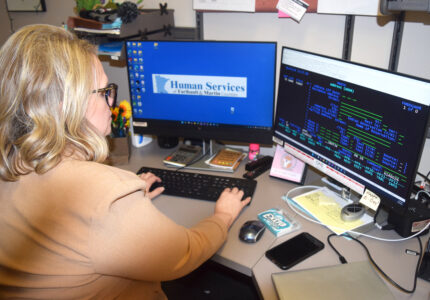
The oldest system is MAXIS, which Financial Assistant Supervisor Emily Hanson said handles quite a bit for FMCHS.
"With our financial department, MAXIS is going to be where we are determining eligibility for SNAP, cash assistance, some types of medical assistance, or long-term care," she said. "If we look at quarter one for 2026, we had 4,247 cases between Faribault and Martin counties. It’s a very significant number of cases that we’re handling, households as well as people."
Each of these cases is a household, meaning there could be multiple people under one case, such as with a family.
How old is MAXIS? It was originally released for Health and Human Services use in 1989. For reference, this predates the first search engine, DVDs and the release of the World Wide Web, which is the predominant way people use the internet today. Because of this advanced age, Hanson said everything has to be manually entered.
"If we get a paper application or we get something online, our staff have to take information from that, and then manually enter it into the system," she said. "Nothing pulls over, so it’s very clunky, very cumbersome. Once people are known into the system, it can speed it up a little bit."
Even so, hours can be spent daily on just putting all the necessary information in from applications to MAXIS. On top of this, Hanson said MAXIS doesn't work well with SSIS, used by social services and originally launched in 1999 but still receiving updates, and METS, used for MinnesotaCare and Medical Assistance.
"Our systems don’t talk well to each other," she said. "If somebody has a health care case on our METS system and is on SNAP, they don’t talk to each other at all. If they called in and talked to their SNAP worker and said, 'I want to report that I had this change.' They could enter that change into MAXIS, and they would have to then go manually enter it into METS as well, because it doesn’t just update both."
Human Services programs have also changed plenty since 1989. Even with updates, this means it’s not just putting in information repeatedly; it's remembering how to do it correctly each time to reflect current policies.
"Our programs are not getting easier complexity-wise," Hanson said. "They’re actually getting more difficult. The system doesn’t handle those changes well at this point. A lot of times, what we’re seeing is that we’re having to do workarounds. It’s a lot of manual things that workers are having to remember to do to make sure their cases are processed correctly. It’s a lot of time."
Because of the time spent on all of this, there are fewer requests they can process in a given week or month, which can bog down the system over time.
"Our workers care a lot about making sure that they’re doing their job well," Hanson said. "They want to make sure that they’re issuing accurate benefits. The amount of work that we could push through would really increase if we didn’t have to do some of those manual things."
While these systems are old, FMCHS is able to continuously update physical technology on a rotating basis to different departments. This includes laptops, computers and monitors. But running old software on new hardware has presented its own challenges from time to time.
"It was Microsoft 10 or 11," Hanson said. "We couldn’t put those on our computers because Maxis did not like it. Right now everything seems to be going pretty well. Our IT department does a really great job of making sure that we have the updates we need."
Funding to update this software is something Hanson has had her eye on for a while, as she said has been a recurring topic for numerous budget sessions.
"I had the opportunity to spend the day on the hill in March 2025 and speak with some of our legislators in our area," Hanson said. "I talked to them about the importance of updating our technology. I think they know that it’s important; it’s just a matter of making sure that the money is there to actually update it."
It is still very early on in the process. Hanson said she expects decisions are still going through the state departments as to how this is going to work, as they have not received any info yet. While she hopes all of the issues they have with MAXIS, METS and SSIS are resolved by this, Hanson is utilizing patience as things work their way through the system.
"We know things don’t happen overnight," she said. "That’s just not the nature of how government stuff works, especially when it comes to funding. We’re really hopeful, but we don’t really know what this is going to look like. Until much more solid information comes down to us, I think it’s a bit of a guessing game of exactly what’s going to happen."
State Representative Bjorn Olson confirmed that the $90 million has been allocated, which he said was the hardest part, and now they will begin work to see who will develop the new system and how it will work.
“Now they have to go to the software developers to develop something that will fit the needs of our state and our counties,” he said. “I don’t have a timeline for when our county will have that new software. At this time, I would bet that they’re looking at bids to see who can create a program for us.”