
City details CLP harvesting plan
Trending
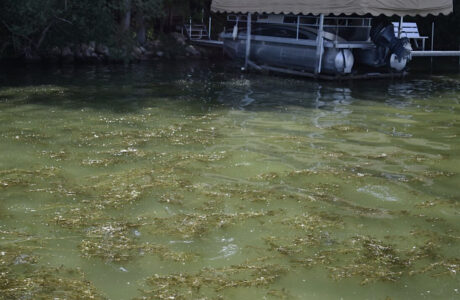
FAIRMONT-- One of the efforts the city of Fairmont is taking to combat Curly Leaf Pondweed (CLP) in the chain of lakes is harvesting and its contractor, Premier Lake Harvesting, started doing that just last week.
CLP is an aquatic invasive species that started being really visible in the Fairmont chain of lakes in 2023 though the Department of Natural Resources (DNR) first has record of it being in Fairmont in 1993, though it may have been here sooner.
In December of 2025, after a Request for Proposal (RFP) process, council had directed the city's legal team to draft a contract with the chosen company, Premier Lake Harvesting, which is based in Minnesota. Per its website, Premier has serviced more than 100 lakes across Minnesota, Wisconsin and South Dakota.
At its meeting on March 9, the council had approved a portion of the contract, which it called phase one, as there were some questions and caveats about phase two.
Economic Development Coordinator, Ned Koppen, said that Premier started on time as scheduled the week of May 18.
"As soon as they felt it was optimal harvesting time, they were on the water," Koppen said.
Prior to starting the harvesting, Premier and city staff worked to determine, months ago, where the need would be, attempting to target areas where it would be thicker, along with boat landings and inlets and outlets of channels where the traffic area is higher.
However, at the end of the first week, its harvester had an engine go out and it's been out of commission since. The plan is for the harvester to be back out on the lakes at the start of next week.
"In the original contract, the language within the RFP and then Premier's contract, was for a phase one and phase two. All of that work was approved originally and then council double-backed and asked, 'Can we just do phase one and then have Premier come back and report on process, progress and then we can approve phase two,"" Koppen said.
Premier is expected to be at the city council meeting on June 8 to give a progress report and at that point council could make a decision on phase two.
As for what phase one all entails, Koppen said they started on Amber Lake and then moved to Lake Sisseton and then the final part of phase one is a section on the north end of Budd Lake.
"That will complete phase one and then phase two would be the rest of Budd, Hall (Lake) and George (Lake)," Koppen said.
However, as Public Works Director, Matthew York, said, it's not the entirety of every lake that will be harvested.
York explained, per the DNR, that you can only remove up to 50 percent of the littoral area, which is the surface area with a depth of 15 feet or less. The reason for that is to not clear cut the eco system within the lake.
Of all five lakes, there's about 900 littoral acres that can be managed.
"For example, George Lake has 83.16 acres of littoral area, which means that we can only do aquatic harvesting in about 41 acres," York said.
He stressed that not all CLP will be eradicated and that the harvesting will need to be done over the next few years.
"The turion (CLP seeds) stay in the ground for three years so if we're not harvesting the same area for three consecutive years, we'll continue to have regrowth," York said.
With that said, Koppen said that the city is committed to making a good effort at alleviating the problem of CLP within the bounds that the DNR allows.
In addition to harvesting through its contract with Premier, Koppen said that for the second year, the city is also contracting with Waters Edge. Lake property owners who opt to harvest CLP themselves can have it picked up, either at the dock on at their curb, by Waters Edge at no charge.
"The city council approved some budget to hire Waters Edge for that," Koppen said. "Go to the city's website (fairmont.org) or the city's Facebook page and you can schedule a pickup, which will always be on Mondays."
Another step the city is taking to combat CLP is that the water resources department entered into a contract with Minnesota State University- Mankato to do a study on CLP in the chain of lakes. Koppen said the research team was here prior to the start of harvesting, at the start of harvesting and will check in again soon on the progress, along with at the end of the harvesting.
"They'll generate a report based on that study for us so that we can understand a bit more on what happened this summer in addressing Curly Leaf Pondweed," Koppen said.
The city does recognize it's putting forth a more concentrated effort in recent years to address the condition of the lakes, especially since CLP has become so visible.
"It's a bigger effort out of necessity," Koppen said.
York added that the city is at the start of multiple steps to combating the issues.
"I think there's a learning curve that comes with it. We're really stepping into it and taking in a lot of information. It is a priority for the city. The lake is kind of a premier thing for us here," said City Administrator, Jason Baker.
He added that the city is open to other ways of addressing the problem, many of which have been discussed by the Lakes Management Committee.