
Testing gives science-based data for Fairmont lakes
Trending
FAIRMONT-- A partnership between the city of Fairmont and Minnesota State University-Mankato will result in comprehensive scientific data on the Fairmont Chain of Lakes. The $25,000 contract started on April 1 and will go through Dec. 31 of this year.
Fairmont's Water Resources Coordinator, Hannah Neusch, acknowledged that while the water treatment plant in Fairmont monitors and tests the drinking water pulled from Budd Lake, Fairmont's chain of lakes haven't really ever had a comprehensive study done on them.
"I don't think we've ever done a project like this on our lakes. This will be a first time event and I'm hoping that it's really a turning point. We all know that our lakes need help. They're one of our greatest assets, but we have to help them and know how healthy they are first," Neusch said.
She said that previously MSU had worked with Martin Soil and Water Conservation District to complete a survey of the lakes which shows where the Curly Leaf Pondweed (CLP) was growing.
The survey was needed to turn into the Department of Natural Resources (DNR) in order for the city to get a permit for the mechanical harvesting of CLP, which is being done by Premier Lake Harvesting.
Neusch said that while the city has been in contact with MSU for about three years, the survey was completed in 2025.
"Basically it tells you where all the different plants are growing in our lakes, which includes Curly Leaf Pondwed and other plants, such as native vegetation which is an important component of their research study," Neusch said.
She went on to say that as CLP is removed, there shouldn't be just bare sand in areas because that's not the way the lake system should be.
During the survey, along with looking at the CLP and native species, they also took some samples of the sediment to see where the turions, or CLP seeds were, to determine where the heaviest areas of the weed would be.
This led to discussions of further testings on the lakes.
"We came up with a plan to essentially continue doing that testing," Neusch explained. "We wanted a really good wholistic view of what's going on in the lakes. That was the initial approach."
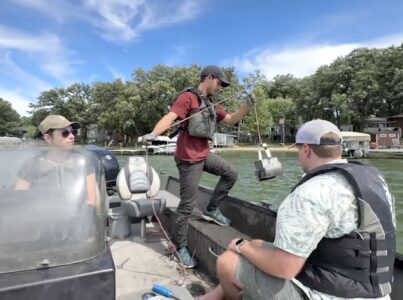
A contract was then developed and approved by council and now this further testing, which began in May, is being conducted by a research team that's assigned specifically to Fairmont's lakes.
"They have a passion and an interest in taking care of our lakes," Neusch said.
Dr. Ryan Wersal, who has been working with the city and studying Fairmont's lakes for a number of years, is the lead professor but a graduate student at MSU is taking the reins of the project and has a team of undergraduate students working with them.
"Him and his team are down here at least once a month. They have established testing points in each lake. They're going out to exact GPS points each time to do certain tests," Neusch explained.
The water quality monitoring will show how the lake is cycling and how healthy the water is for the ecosystem itself.
"They'll be doing monthly water sampling, testing for phosphates and nitrates at a permanent water sampling location in each lake," Neusch said. "It's more than someone going to the lake everyday and saying, 'the water quality is better than it was before.' We really need those data points to be able to guide us."
The team is not only testing the water, but testing for turions and core samples of the lake bed to get a data set and some trend lines to help guide the city's lake management for the future.
"We don't have a data set as far as I know for any of the water quality really besides the drinking water intake. As far as ecology, fishing, swimming, it's really just a visual. It looks good, or it doesn't," Neusch explained. "So we don't have any idea if the things we might be doing and spending money on are working."
One other new thing the city is doing this year is having the CLP harvesting by Premier Lakes Harvesting. While the company is removing CLP, they're not doing any testing so Neusch said the team from the University is testing in places where harvesting is being done, and places where harvesting is not being done to see if an impact is actually being made.
At the end of this year's study, the team will supply the city with the entire data set and any conclusions that it has come to.
"I'm hoping that if council is amenable and the public is interested in continuing this, I'd like to see if the University is interested in doing this, if not every year, than every three years or five years to see if we're actually moving in the right direction," Neusch said.
She pointed out that while the city has a few different projects going, including the CLP harvesting and rain barrel program, it's hard to know if any of it is making more than just a visual difference.
"Science says they're effective but we don't know if they're actually affecting our lakes in a positive way until we have data," Neusch said.
She stressed both excitement and pride in these projects and hope for what they mean for the future of Fairmont's lakes.
"It's really going to push our water quality management and lake management forward because we'll have a basis to stand on to decide whether or not these things are working," Neusch said.