
Police Department adopts toolkit for people with disabilities

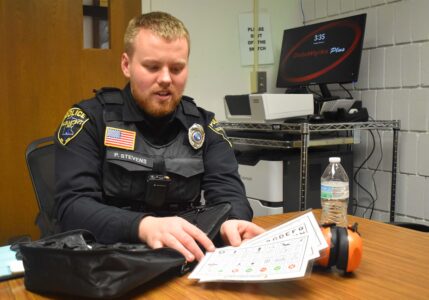
ABOVE: Fairmont Police Officer Parker Stevens flips through the communication cards in the Autism Toolkit, which assist people who feel overstimulated or non-verbal with communicating. The kit was provided by Bean and Bear Founder Jamie Klug and funded thanks to the Minnesota Chiefs of Police Foundation Grant Program and Hawkins Chevrolet.
FAIRMONT – Thanks to funding from the Minnesota Chiefs of Police Foundation Grant Program and Hawkins Chevrolet, the Fairmont Police Department has received several Autism Toolkits to assist people with disabilities and law enforcement when they interact.
The kits were made by Bean and Bear, a project started by Arise Academy Special Education Teacher, Jamie Klug. The project is named after the nicknames of her nephews Eli and Oliver, who both have autism. They also inspired this initiative.
“I’m used to seeing their meltdowns,” Klug said. “I’m used to seeing them dysregulated. I’m used to seeing them need to stim but it’s not something, if you’re not familiar with autism, that you’re used to, and it can look very scary.”
After seeing a news story last May of someone with autism losing their life in an interaction with a police officer, Klug felt the need to reach out to the Fairmont PD about her idea, which she did by talking to Patrol Officer and Arise Academy Resource Officer, Parker Stevens.
“It came down to, ‘How are we gonna afford this?'” he said. “Everything costs money, and working with limited budgets, we had to figure out how we’re gonna be able to afford it. We spoke to then-Chief Michael Hunter, and he said this would be something eligible for the Minnesota Chiefs of Police Association grant. He applied, and we were awarded approximately $1,800. Hawkins Chevy had a first responder donation, and we were able to use that funding as well to help fund the program.”
Overall, compiling all the toolkits, including sufficient toolkits to cover all PD and Sheriff’s vehicles, they cost approximately $2,800. The kit includes fidgets, sunglasses, communication cards featuring common and emergency phrases, as well as a number pad, noise-canceling headphones and a weighted lap blanket. Stevens said the cards are one of his favorite parts.
“This is something we can really use on the streets interacting with individuals that might be non-verbal,” he said. “They can point to what they need. Police, fire, they’re hungry, are they confused? It’s also for phone numbers, because a lot of individuals with autism can point to their parents’ phone number.”
In addition to this, Klug said the headphones help with potentially overwhelming sounds, sunglasses help with bright lights and fidgets occupy them and help them take their minds off an emergency situation. She also clarified that this is not just for kids, but for anyone who could benefit from these tools.
The first kits came in around Christmas and have already been utilized within the community. So far, the response from community members has been positive, and Stevens said there is more they’re looking to do with Klug.
“She’s gonna actually come out and teach officers [on the toolkits],” he said. “Hopefully, the whole department, as long as we can make it work. It would be really nice to have in-person training with Jamie, who handles it firsthand every day.”
Through this open adoption and acceptance of tools and training for better experiences with people with disabilities, Klug said it’s helping a crucial demographic that’s very near to her heart.
“The families I work with have been very receptive to it,” she said. “They’re just so thankful for things like this, just to help them keep safe. Just the community aspect of it for me is something great. We see such negativity around law enforcement, teachers, autism, even community in general. I love the community collaboration with this, and they’re just so open to working with me.”
Looking forward, Stevens said the program is still very new, but it is something they will evaluate and hopefully be able to budget funding for when new materials are needed. Klug said she is looking to make Bean and Bear into a non-profit that can present these toolkits as an option for safety and accommodation to as many police departments and sheriff’s offices as possible.
Local News
Sherburn Legion Hamburger Night tonight
SHERBURN — The CREST Lunch and Learn program will be at 11 a.m. today, Feb. 4 at the Sinn Family Celebration of ...
Faribault Co. OKs new alert system
BLUE EARTH— Citing the need to have a faster response time in case of emergencies, the Faribault County Board ...
Shotgun only ordinance fails 3-2 in Martin County
FAIRMONT— After a lengthy discussion on Tuesday, the Martin County Board of Commissioners decided by majority ...
Sherburn looks into contracts and repairs
SHERBURN — During the Sherburn City Council’s meeting on Monday evening, a Cornerstone Management company ...
Police Department adopts toolkit for people with disabilities
Briefly
Fairmont Speech competes at Wayzata tournament FAIRMONT — The Fairmont Speech Team competed at the Wayzata ...