Museum offers chance to see, learn

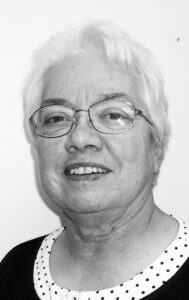
ABOVE: Martin County Historical Society’s Executive Director, Lenny Tvedten, stands inside the museum’s School Room. The room is one of several that displays different artifacts and information on the county’s history.
FAIRMONT– The Martin County Historical Society and Pioneer Museum in Fairmont is the one-stop shop for finding out all about Martin County’s history. The museum offers much more than artifacts to look at, but opportunities to interact and dive deep into any area one wants to learn more about.
On Tuesday, Jan. 10, an article in The Star Tribune shared one man’s journey through all of the county museums in the state of Minnesota. The man ranked his top three county museums and the Martin County Historical Society was at the top of his list.
The Martin County Historical Society has been in existence since January 1929 and was originally housed in a room at the Martin County Courthouse in Fairmont.
The campus the museum is currently on, at 304 E. Blue Earth Ave., has been there since 1956. It was purchased by Dr. Roscoe Hunt and was originally St. Paul’s Convent School. An add on to building was built in 1995.
The house next door, called the Pioneer personage, was purchased in 2009. It’s been renovated to replicate a 1910-1930 home. The space is rented out and used for gatherings and celebrations.
According to the Minnesota Historical Society, every county in the state, all 87, has at least one museum, though Martin County Historical Society’s Executive Director, Lenny Tvedten, said the sizes, displays and hours of each museum varies.
“Obviously Fairmont is the largest community in Martin County so there may be more things representing Fairmont,” Tvedten said.
Though all cities and towns in the county are well-represented in the museum.
Tvedten, a retired school teacher, began working at the museum in 2001. While he had planned to stay just two years, he’s been there more than two decades.
Along with Tvedten is curator, James Marushin and administrative assistant, Donna Paris. This past summer for the first time, the museum had an intern through the Minnesota Valley Action Council/Martin County summer youth program. Right now, Tvedten said they also have an intern working with them as part of a class through Minnesota State University- Mankato.
“It’s always inspiring to see younger people interested in history, especially local history,” Tvedten said.
Nearly everything at the museum is the result of donations either given by families, businesses or organizations. While the items vary greatly, they have one thing in common as they all have a tie to Martin County.
There aren’t just artifacts, but photographs, documents and family genealogy. Tvedten said they attempt not to have duplicates and for that reason sometimes need to turn away items. Unfortunately, they also need to turn away items from time to time due to space limitations.
“Things are pretty crowded and we don’t have the ability to continually rotate displays due to storage,” Tvedten said.
While there may not be much storage, there is plenty of space to display the treasures the museum has. It boasts several different themed rooms including the Carlson Room, Pioneer Room, Brodt Room, Military Room, Hunt Room, Welcome Room, School Room and Research Room.
Tvedten said he thinks some of the more interesting artifacts and displays they have are the music display, which highlights local “garage bands” from the 1950s and 1960s.
“That’s really of interest to people,” Tvedten said.
Another display that’s of interest to people who come through the museum is the School Room. In the room are many yearbooks from all of the county schools and Tvedten said that when class reunion groups come in they always enjoy the school room. The room also includes school items from different eras and some different band outfits from county schools.
“In the Carlson Room in the basement are some larger items like the 1923 American LaFrance fire truck, the first motorized fire truck in Fairmont. There’s a Model T Ford and an iron lung,” Tvedten said.
Personally, Tvedten said he thinks the most interesting and functional room in the museum is the research library.
“You can spend hours in there researching the history of Martin County and you can get so easily sidetracked looking at a 1970 newspaper. Maybe you’re looking for a specific subject and you see an ad for Gunther’s Food or whatever. It’s really interesting,” Tvedten said.
In the Research Room the walls are lined with Fairmont Sentinel copies dating back to 1874, which are also available on microfilm for the years 1900-present.
Of course, the museum serves as a way not only to preserve, but to educate all people in the county on its history. A target audience of this goal is students.
All of the schools in the county– whether they’re public or private– are invited to come in and tour the museum. An age related activity, like a scavenger hunt, is provided for the students. For those tours Tvedten said he relies on retired teachers or volunteers to
help out.
“They have the opportunity to learn and come back,” Tvedten said.
During the year of Covid, 2020, Jeff Rouse and Our Story Studios made a virtual tour of the museum so school children and the community would still be able to “tour” the museum, as it was closed.
Tvedten or Marushin also often go out and provide historical presentations to those in assisted living facilities or to various service clubs. Similarly, other groups may come in and tour the museum.
In 2019, work on a new interactive room inside the museum began. While the project was halted during Covid, Tvedten said they’re beginning to work on it again and hope to have it finished sometime this summer.
As for interesting research requests they’ve had, Tvedten said they helped the great-grandson of the first mayor of Fairmont, who came in 2019 and was interested in learning information about the family lineage.
Another personally interesting request for Tvedten is when he got a call from Presidential Historian, Jon Meacham, who called asking for information on Martin County-native, Walter Mondale, after the 42nd vice president passed away.
Tvedten said through his job he’s met many different people either at the museum or through research requests. He’s also had the opportunity to meet many Martin County natives through work on his book, “Martin County Veterans: Their Sacrifices, Our Freedom.”
“Meeting them and hearing their stories are very interesting,” Tvedten said.
The historical society is a non-profit and while it’s not owned by the county, it is supported by it. Tvedten said they rely on donations and grants and do have an endowment that has grown over the years. The historical society also has a year-end fundraiser which it’s been holding for the past decade.
“We rely on the support of the community and businesses,” Tvedten said.
What keeps the historical society going is the work of the staff, board, volunteers, donors and the support of the community, whether it’s coming in to take a look around or donating an artifact for others to enjoy.
“It takes the interrelationship of all of those aspects to make it work efficiently and effectively,” Tvedten said.
The museum is open year round from 8:30 a.m. to 12:00 p.m. and 1 p.m. to 4:30 p.m. Monday through Friday. Extensive information can also be found on its website, fairmont.org/mchs.
Local News
Couple returns to Fairmont, brings business with
Possible shark tooth found on sand bar in New Ulm
Months of work culminate in success for CER
Briefly
FHS student welders excel at Regional FORGE Welding Competition FAIRMONT — A team of five student welders from ...
Speech riding section championship heading into state meet