
The Southern Minnesota Crisis Support Center
A Brief History
Trending
What is a crisis? A crisis can take shape in many forms. According to Mirriam-Webster, one definition of a crisis is as follows: "an unstable or crucial time or state of affairs in which a decisive change is impending." If that impending change is not one that is wanted, beyond one's control, or not planned, that change might be considered to be a "crisis" to the individual concerned.
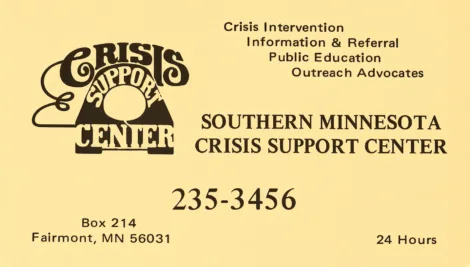
In the 1970's, an organization meant to aid individuals in a "crisis," was a Crisis Support Center. This center served Martin, Faribault and Watonwan Counties and was called the Southern Minnesota Crisis Support Center. "The center's main areas of interest was on child abuse, sexual assault, battered spouse, chemical dependency and youth crisis."
How did this service come into existence? "The founding group is made up of members of several organizations: American Association of University Women; Business and Professional Women's Club; League of Women Voters; Jaycee Women, local members of the Governor's Bill on chemical Dependency; Tri-County Human Services and other interested citizens."
This 24-hour, seven-day-a-week service was staffed entirely by volunteers. Volunteers were trained emphasizing that strict confidentiality and anonymity be maintained for both callers and volunteers. Names were not required unless voluntarily provided. Hotline volunteer workers had to complete a final screening before approval for the hotline, however, no volunteer member was required to answer phones.
According to the September 6, 1978, issue of the Sentinel, the Crisis Support Center planned a series of volunteer training sessions at the Fellowship Hall in St. Martin's Episcopal Church in Fairmont. The first session featured Fairmont attorney Richard Berens who explained legal issues and answered questions. Additional sessions were scheduled every Thursday through October 12 and covered counseling techniques, battered-spouse issues, child abuse, chemical dependency, and youth problems. The organization hoped to provide public information and education along with contact numbers to call for potential volunteers.
According to the September 30, 1978, issue of the Sentinel, the hotline was the only multi-crisis line in the area, but it would not turn away callers from elsewhere. At the time, the center was developing an advisory board made up of Fairmont professionals. The article noted that fourteen volunteers had committed, though twenty-two were needed. While some questioned whether the area needed a hotline, one volunteer responded, "I've been amazed what needs there are."
On February 21, 1979, a Sentinel article stated that the Crisis Support Center expanded their presence by providing public information sessions on crisis intervention and area referral services. These were free sessions open to anyone, and mandatory for potential volunteers. Sessions were scheduled to be held at the Alano Society on N. North Avenue. The sessions were meant to help volunteers become good listeners, develop phone skills, become aware of child abuse concerns, and provide an orientation of the Crisis Center's history and objectives. In addition, the article stated that code names were used by both volunteers and callers and that "diverter" telephone equipment was used by the center that allowed volunteers to take calls in their homes during the day or on late evening shifts.
"Contrary to popular belief - sexual assault, child abuse, battered spouse, chemical dependency, and youth problems do exist in Fairmont and the tri-county area." This story went on to emphasize the importance of confidentiality, that all ages of men and women call at all hours of the day, and that the main purpose of the hotline is for volunteers to help put the caller, who's having a crisis, back in control of the problem. The article emphasized that the most urgent crisis was suicide. Regarding the suicidal caller, the hotline volunteer would first attempt to develop a trust relationship with the caller emphasizing that their main concern was the immediate safety and needs of the caller. They were to make every attempt to get professional help for the suicidal caller immediately.
In summary, the Crisis Support Center of that era was intended to help people of all ages, both male and female, regardless of the kind of crisis they were experiencing. It also served as an advocacy service and provided education. If requested, volunteers would also accompany individuals to medical examinations, a detox center, or even a trial.
The Crisis Support Center of that time provided a much-needed service to many who had nowhere else to turn. In that respect, the value of the services provided by its many volunteers cannot be overstated, and there is no doubt that the gratitude of those who received help was equally profound.
For more information on this topic, or to become a member, visit the Pioneer Museum in Fairmont, or its website at www.martincountymuseum.com