
The Legend of the Sisseton Oak
Trending
With the recent finding of human remains in Sylvania Park in Fairmont the following is a reprint of a 2009 article entitled "The Legend The Sisseton Oak." This article is based on the April 12, 1895, edition of The Martin County Sentinel entitled "Tradition of The Sisseton Singer" and "Legend of the Sisseton Oak" by Major Arthur M. Nelson, and a comment by Frank Day, all of which describes a legend associated with our local history.
Legends are occasionally intertwined and woven into historical accounts and might certainly generate added interest. Dictionary.com defines a legend as follows: "a nonhistorical or unverifiable story handed down by tradition from earlier times and popularly accepted as historical." In the study of history, there are sometimes legends that become an almost accepted account of historic events, even though they are not objectively documented.
The setting for the legend of the "Sisseton Oak," sometimes referred to as the "Singing Oak," was described as an ancient oak tree measuring nearly four feet in diameter having gnarled, decaying, and broken branches. It once stood in the northwest corner of Sylvania Park in Fairmont. The Martin County Sentinel article stated that at one time, when the area was wilderness and inhabited by the Sisseton Sioux, there was a famous singer among them. He was known throughout the whole Sioux nation and considered extremely talented in song and poetry and thus greatly admired by the Sioux people. Although his songs frequently ridiculed war and bloodshed, which often incensed the tribal leaders, he still maintained his immense popularity with the people of the Sioux nation.
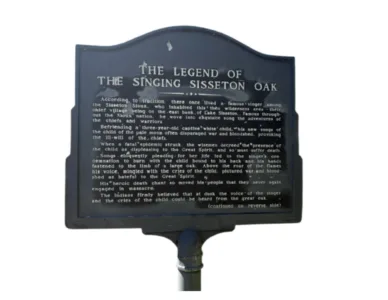
One evening in August of an undocumented year, as portrayed by the legend, the Sisseton warriors returned from an expedition with but one captive, a Caucasian girl being about three years of age. The Sisseton Singer befriended the child and they soon became very attached to each other. All was well for a time, as the child was seemingly happy and the Singer's songs delighted the many listeners, some of which referred to the little girl as "the little child of the pale moon - a star dropped down into the Sisseton Village." However, a fatal epidemic, which was likely smallpox, appeared in the tribe that would soon prove ominous to the Singer and the child.
As a result of this epidemic, a council of the wise men was called regarding the outbreak. It was their unanimous decision that the Great Spirit was displeased with them due to the presence of the white child in the tribe. Therefore, in order to regain the approval of the Great Spirit, they believed that the child must be put to death. The day was set for the sacrifice and runners were sent to inform the villages along the lakes. The news was initially met with jubilation among all, with the exception of the Sisseton Singer. He went to all the villages pleading for the life of the young white child through his songs. His message carried in song so influenced the people that they soon openly condemned the action to be taken by the wise men of the tribe. This so enraged the tribal leaders that they met once again and, as a result of the Singer's actions, condemned him to die with the child the following evening.
The subsequent evening, the child was bound to the Singer and they were led to the large Oak tree in what would later become Sylvania Park. They were fastened to a large limb that extended out over the lake and dry fire wood was placed beneath them and ignited. What happened next, according to the legend, is that the Singer met a heroic death by continuing his song above the hiss and crackling of the fire telling of war and bloodshed as being hateful to the Great Spirit and telling of coming peace among all tribes when violence and torture would be unknown. The Singer's tragic death and words of his song so influenced the people that from that time on they no longer engaged in war and massacre. The article from the 1895 edition of the Martin County Sentinel goes on to state, "And it is a matter of history that at the time of the great Sioux uprising in '62 the Sisseton's under their aged chief, Standing Buffalo, were the only ones that remained passive and did not make war on the whites."
The remains of the two victims were gathered and buried in the sand near the water's edge of Sylvania Park. The Indians believed that when standing at the foot of this oak tree at dusk, the voice of the Singer and the cries of the child could be heard. As a result of this, they moved their village north to Buffalo Lake.
The white trappers and hunters of that time also believed the legend and avoided the area, and others unaware of the history of the event claim to have heard the voice of a man singing and a child sobbing. Frank Day also commented in April 12, 1895, Sentinel as follows: "Although natural causes cannot explain, and though the voice of the singer may long have been hushed in death, his songs live on and find an echo in the souls of the living."
A historical marker at the entrance of Sylvania Park quotes Major Arthur M. Nelson as he reflected on visiting the site: "I am free to admit that a feeling of indescribable dread, if not fear, crept over me when there came in my ears much more distinctly than ever before a man wildly singing, mingled with the agonizing cries of a child." In further paraphrasing his words in reference to his initial thoughts that the sounds were caused by natural phenomena, Nelson states that he came away believing that there is much in life and beyond that natural causes cannot explain.
The Oak tree, which no longer stands, was mysteriously destroyed by fire in June of 1908. Nelson's article states that evidence would seem to indicate that it was struck by lightning or that perhaps it had been smoldering at its heart ever since the cremation of the singer. An engraved marker on field stone is located in the northwest section of Sylvania Park identifying the location of the "Singing Oak" tree. This local legend lives on in Sylvania Park. Is it real, or merely a fictional account of history? Perhaps your decision can be reached by visiting the site in the Northwest corner of the park at dusk.
For more information on this topic, or to become a member, visit the Pioneer Museum in Fairmont or its website at martincountymuseum.com.