
Fairmont locals experience the Gothia Cup
Trending
FAIRMONT - The trip overseas has concluded.
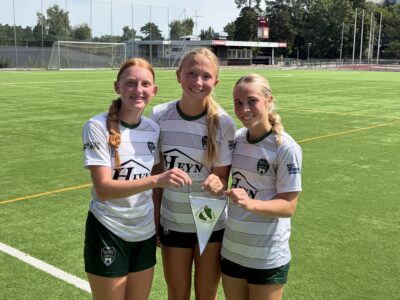
Local Fairmont teens Mollie Leiding, Makenzie Gerhardt, and McKenna Ludacer have returned from Sweden after competing in the Gothia Cup, a week-long event hosted by BK Häcken that is typically referred to as the World Youth Cup.
From an eye-popping opening ceremony to representation across the globe, this event does more than pit fabulous soccer competition amongst each other. It's an opportunity for individuals to learn about other countries’ cultures both on and off the field. A once in a lifetime experience.
"It was kind of like the Olympics," Gerhardt said of the opening ceremony held at Ullevi Stadium in Gothenburg, Sweden. "They announced every single team, and had representatives of each team walk through the area. There was a concert, fireworks and games."
What is the Gothia Cup?
The Gothia Cup has been established for 51 years. Ages 11 to 18 are permitted to join, with participation open for all clubs who are members of their FIFA affiliated national association. Special Olympic teams have been competing for the Gothia Special Olympics Trophy since 2011, thanks to former Swedish National Player Kim Källström.
The inaugural 1975 tournament had 275 teams, but the event has simply soared in popularity and country representation since. Statistics from the most recent tournament showed 1,964 teams from 77 nations. A staggering comparison from its origin.
Much like the FIFA World Cup, the Gothia Cup revolves around a similar bracket structure. Teams are initially split into groups of four or five. Each team plays one another to determine seeding in the ensuing knockout stage. The top two teams qualify for Playoff A while the rest form into Playoff B. The single elimination format then picks the winners in each age bracket.
Mankato United, Mollie Leiding, Gerhardt, and McKenna Ludacer's organization, have been coming to Gothenburg for 16 years, with the boys and girls teams alternating every other year for participation.
The girls team was composed of three different age groups across the soccer club - U15, U16, U17/18 - filled with individuals from Fairmont, New Prague, Mankato West, Mankato East and New Ulm.
Local funding and donations played a huge role. Beth Leiding said that for a player and a single parent to travel would cost over $7,000. The group collected resources through different venues such as working at Pizza Ranch, selling popcorn online, rummage/bake sales and numerous donations.
"Just giving a shoutout to the people in the community and their friends in helping support through different fundraisers we did," Beth Leiding said. "This was really planned out in a year’s time, so we spread out some opportunities. ...There was a lot of support. People were very intrigued that they were going and very supportive of the girls. We would all like to thank everyone."
Building chemistry
Mollie Leiding, Gerhardt, and McKenna Ludacer didn't simply partake in this overseas escape to sightsee. They came to make history.
But the journey to a deep run didn't start off on the right track. It began with a 4-0 defeat at the hands of Växjö DFF (Sweden), who scored two goals in each period to come out with a definitive opening game victory.
The initial rocky start was partially due to Mankato United's collective of individuals across the three teams. Other competing clubs have had the privilege of playing together for years, building the needed continuity the sport requires. Mankato United had a handful of practices. Four to be exact.
"We didn't really click until we got to the school," Gerhardt said. "The first three days we were in a hotel in groups of two or three per room. Then we went to Gothenburg for the seven days, all smushed in this school room with a bunch of different countries. So we got really, really close."
"After that first game, losing 4-0, we just started to click," Mollie Leiding said. "After that game, right outside of the school there was a field, and we held a practice. We practiced what we needed to, and the next day we won."
Mankato United took care of its final two group opponents rather comfortably. It started with a 2-0 win over Capiscol (Spain). They followed this with another victory, this time over Ängelholms FF (Sweden), to clinch second in Group 6 and move to the Playoff A bracket.
The following 4-3 win against Vaksala SK 1 (Sweden) in the Round of 32 cemented this year’s Mankato United team as one of the best. It was the farthest any Mankato United team had gone since its participation in the Gothia Cup. Mollie Leiding and Gerhardt ended the tournament tied for the most goals on the team with two apiece.
However, the journey ultimately ended in the ensuing Round of 16. Mankato United was held to zero goals for the first time in three games, with Lørenskog IF (Norway) notching its lone score at the 37th minute to pick up the win.
A lasting impact
The final defeat and elimination of the club wasn't how Mollie Leiding, Gerhardt, and McKenna Ludacer wanted things to end. Not one bit. But the knowledge and experience picked up through the voyage was plenty to be happy about.
Some of the most notable encounters were on the field. The obvious language barrier was the first thing Gerhardt noted when talking about the competition.
"It was definitely cool playing against teams you don't understand," Gerhardt said. "Here in the US, we would hear opponents say to do something, and then we would follow. But we couldn't hear what they were saying, so we couldn't go off of that."
Another difference boiled down to style of play. "Aggressive" was the word all three prep players used to describe the other teams approach to the game, jokingly mentioning slide tackling and the pulling of their jerseys as methods to live out their strategy.
"There's a lot more passing," Mollie Leiding said. "They use a lot more of their backline to the goalie a lot more. It's a lot less boot ball and lots of tackling. They were so quick to be on you, you'd have like two seconds on the ball until you get it off your foot, otherwise they were right there."
Away from the fields, everyday life looked much different than it did back home. Instead of piling into cars, McKenna Ludacer said the group relied on electric scooters, bicycles, trams and even a double-decker bus to explore Gothenburg.
There was an essence of cultural infusion between everybody. Different countries interacted with each other, telling of music, games and just the general lifestyle each one experienced on their own.
"We'd come back from games, and the adults that chaperoned the school would be playing 'Party in the USA,' and they'd watch our games online," Mollie Leiding said with a smile.
This wasn't just found in the living conditions of the soccer players. It was seen throughout the entire city.
"There was a central location where a lot of the Ultra-elite games took place, it was kind of like the center point of the tournament," Eric Ludacer said. "A lot of teams come there. There are some shops, some skill challenges. There, you saw a lot of people interacting with each other. ...We even got a couple people saying 'US, US, US!'"
The trophies stayed in Sweden, but the experience traveled with the Fairmont players, leaving with different perspectives on the sport they love and new memories made during this venture across the Atlantic Ocean.