
PowerOn Midwest scrutinized by public comments
Trending
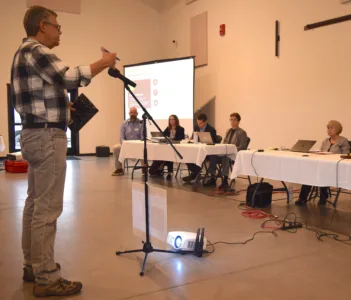
SHERBURN - The PowerOn Midwest project was thoroughly scrutinized by members of the public during a Minnesota Public Utilities Commission Public Hearing in Sherburn on Thursday.
The project seeks to build a 765kV line that would cross into Minnesota from the Brookings Substation, go to the Lakefield Junction Substation in Jackson County, then shoot straight across through Southern Minnesota, including an undetermined path through Martin County, before moving upward from Mower County through multiple substations before ending up at Hampton Substation in Dakota County.
To move the project forward, the state requires a Certificate of Need (CON), which involves proving the project is necessary to meet current and future electricity demand. Part of doing so is having public hearings across the coverage area to hear from the public.
Thursday's meeting, from 10 a.m. to 1 p.m., was the closest one held to Fairmont.
Administrative Law Judge Joseph Meyer oversaw the hearing and was joined by representatives from Great River Energy, Xcel Energy, the Minnesota Department of Commerce and the Minnesota Public Utilities Commission.
MNPUC State Planning Director Scott Ek said the commission considers four questions when determining need.
"First, is the project needed to maintain an adequate, reliable and efficient energy supply?" He said. "Second, is there a more reasonable and prudent way to meet that need? Third, do the project’s benefits justify its potential impacts on people, communities and the environment? Fourth, can the applicants design, build and operate the project in a way that meets state, federal and local requirements?"
This meeting, Ek said, was a chance for people to speak on those questions.
"The commission would like to hear from you whether the applicants, looking at all the information, have shown the need for the project, and whether there may be another way to meet that need," he said.
Before the public comment period, Great River Energy Director of Transmission Planning and Compliance Matt Ellis gave a presentation on the PowerOn Midwest project. He said this project is for reliability, to ensure people can keep the lights on as reliably as they do now. This comes as electricity needs are projected to increase according to Midcontinent Independent System Operator (MISO), which monitors the high-voltage transmission system in the Midwest.
"This project supports your future reliability," he said. "It sets the grid up for not only how we will use electricity in energy, but also how our kids and how our grandkids will use electricity. Electricity usage is expected to change, and it’s expected to grow. MISO forecasts that in 20 years from now, our electrical consumption will be about 25 percent higher than what it is today."
Kent Scholl was one of the first to speak at this meeting. A landowner in Cedar Township, Scholl said he recently retired from Xcel Energy.
"I worked for them for 21 years, 14 years, generation resource planning," he said. "I’ve operated some of the production cost models that have been used in this case. I understand how the modeling is done."
Having looked through the materials, Scholl said the sky will not fall if this project is not approved. Elaborating on this, he used information from MISO included in the project information.
"MISO in the document clearly states, on page 58, lines nine through 17, that the near-term reliability needs in Minnesota can be met with a line that goes from the Dakotas to the Twin Cities directly with a 365 kV line. Working for a utility for 21 years, I kind of understand how that’s operating. You usually only get one bite of the apple to go big, and I really think that’s what the utilities have done here with this project: to go big."
Ultimately, Scholl said he recommended rejecting this proposal until a way can be found to make a less disruptive 765kV line.
In his presentation prior to public comment, Ellis said this project is necessary regardless of whether data centers come or not, and is not being built for them. Karen McConnell invoked Field of Dreams, speaking to her fears that data centers will come as a result of this line.
"If you build it, they will come," she said. "It was stated here today that because of the proposed 765kV line, there is increased interest from manufacturing and data centers to locate along this line. There’s a lot of interest in having a moratorium from our county commissioners and our state in not developing these data centers. I think that we don’t need this line, and if we do build this line, that there will be more data centers built here in our area."
Martin County Commissioner Richard Koons was one of the last of 24 speakers who gave public comments, who were part of the crowd of over 75 people. None of the 24 spoke in support of the project.
Over the course of the project, Koons said he has heard a lot of talk of growth, reliability and need.
"You talked about residential growth," he said. "You’re not talking about Martin County or Jackson County or any of the bottom two tiers of this county, other than Rochester, when you talk about residential growth. We’re losing residents in every one of these counties except for one. Where’s the residential need? It’s not for us."
Ending his remarks, Koons spoke on the direction of PowerOn Midwest's projected line and the source of its power from South Dakota.
"Where’s this going to? It’s going to Illinois, another renewable energy state," he said. "Where’s this power coming from? They told us, and a lot of it’s coal. It’s a pass-through here. It’s not helping us. It’s not doing anything for us. They talk about need. You have shown, all around the Midwest, it’s shown zero need for this."
From here, the judge will issue a report by Feb. 15, 2027 with a recommendation for the commission, and a decision on the certificate of need will be reached by around March-April 2027.
There is an online public hearing that will be available from 6 to 9 p.m. on Nov. 16. For details, including the link, visit mn.poweronmidwest.com/events/ and scroll down to where it says ‘Online Public Hearing via WebEx.’
Comments can be submitted to the email consumer.puc@state.mn.us, mailed to Minnesota Public Utilities Commission, 121 7th Place East, Suite #350, Saint Paul, Minnesota, 55101, or faxed to 651-297-7073. The written form to fill out can be found at https://mn.gov/puc/get-involved/public-comments/.
Comments can also be submitted online at mn.gov/puc/get-involved/public-comments/comment-form/. The comment period will be open until 4:30 p.m. on Dec. 7, 2026. When submitting a comment through any of these avenues, use the docket number CN-25-117.