
Book highlights and explores Fairmont Nolte 36
Trending
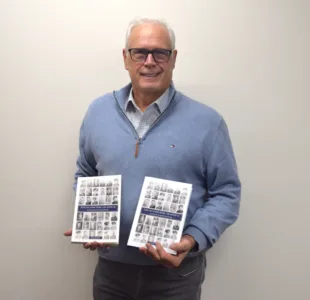
FAIRMONT - The Nolte 36, named for the fact that every single Nolte family member who served in WWII came home alive, has been explored and researched thoroughly by Nolte family member Paul Wessel for his new book, "They All Came Home: The Nolte 36."
The family, which now has extended to 78 grandchildren and 195 great-grandchildren, started with Carl and Louise Nolte. They moved to Martin County in 1885 and purchased 200 acres of land three miles west of Fairmont.
While members have been covered in newspapers and ceremonies before, including by Tom Emmer, who was Majority Whip in the House of Representatives at the time, more extensive work had not been done.
"No one ever asked, what did these men do?" Wessel said. "Where did they go, and what happened?"
Also, Wessel said thankfully he had the agency and resources to undertake traveling for this book.
"It required traveling to Georgia, Florida, Texas, St. Louis and College Park, Maryland. All of these are different resource areas from which a number of the Noltes served, whether it would be in basic training, an air squadron division, or whatever."
In addition to the standard benefits first-hand accounts provide, it was also a necessity in some cases for Wessel.
"Personal visits were required because there are two things that happened," he said. "In 1973, there was a fire in St. Louis that destroyed about 16 million Army records completely. They had no backup. About 80 percent of the Nolte men were in the Army, so that made the process of rebuilding each one of these records very challenging. Secondly, World War II records after 1944 are not online, and so you have to go to the physical repositories of that information to extract some of the information you’re looking for."
Thankfully, Wessel was able to collect information from organizations such as the National Archives and Records Administration, Golden Arrow Research and the German WWII Museum. Overall, he used information from around 6,000 documents.
With all the information at his disposal, Wessel then broke down how the book was going to be written.
"First of all, which men never made it out of basic training because three of them were discharged after basic training due to medical reasons," he said. "Now you’re down to 33, and the next layer was which ones stayed stateside and were not involved in either the Pacific or the European theater of war; then I broke it down into Pacific theater and European theater of operations, so that’s how I stratified it. There were many of them that saw really, heat of the battle stuff, and I focused and dedicated a chapter to each of those men."
Through writing it in this fashion, Wessel said what surprised him the most was how much the Noltes he interviewed learned from him as he learned from them.
"Men from that generation did not share what they went through with their children," he said. "One of the more surprising things I took away from this is I gave the children a lot more information about their dad that they didn’t know, and that was really fulfilling because it allowed some more completeness to why dad was the way he was growing up and different things like that."
From start to finish, the book and its research took around two years. With everything completed, Wessel said it's the storytelling he built upon that is so important for this project.
"My work built on previous work of other Noltes that did genealogy and all that," he said. "I don’t look at it as goals completed, but as something that’s handed down for someone to take and even do more work out of, because there’s so much more uncovered fresh ground to look at. I uncovered a lost Medal of Honor recommendation for Earl Nolte, and had I not done this research, we would not be where we are today."
Thanks to that research, Wessel said there is a bill in the House of Representatives that would allow the Army to adjudicate the Medal of Honor recommendation of Earl Nolte, potentially posthumously awarding him the medal and making him the first man in Martin County to ever receive one.
In addition, an organization named after the Nolte 36 has been formed. Based on the undertaking Wessel went through to get records for his book, the Nolte 36 Organization is slated to help other families seeking assistance in tracking down military service records as well.
The official book release event will be at the American Legion in Downtown Fairmont from 1:30 to 5 p.m. on Nov. 14.