
Area officers take in crisis training
“To de-escalate situations is the safest route.” — Fairmont Police Chief, Mike Beletti
Trending
FAIRMONT - About 30 people from area agencies spent the last five days in a 40-hour training, working on necessary situational skills with the Minnesota Crisis Intervention Team.
The team goes across Minnesota helping law enforcement and emergency agencies learn how to help people in crises.
"We need to be able to identify what symptoms we're seeing and behaviors that we can use the correct communication and de-escalation tactics to work with them," Mental Health Presenter Morganne Napoleoni said. "I don't care why you're manic, if you're bipolar, if you use meth, but I need to be able to talk to you either way. Some of those things do overlap symptom-wise, so what we're hoping to do is to be able to get everyone to identify what mania looks like, to be able to interact with that person."
To do so, Napoleoni said they do a significant amount of classroom training. She said this can often be the hardest part, as it is a lot of information at once.
"We're teaching them the language and the skills through classroom PowerPoints and discussion," she said.
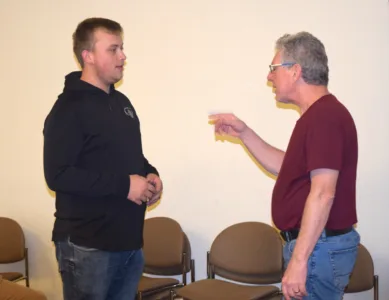
The other part of the training is acted-out scenarios. CIT brings in professionally trained actors to mimic people in various stages and types of crisis.
"They display that symptomology so they can practice in real time those skills they are developing in the classroom," Napoleoni said.
As with any other skill officers and emergency workers must learn, Napoleoni said this training approach helps them build real-life muscle memory on top of the soft skills they learn.
"We try to build stressful situations so some of these thoughts come to mind," CIT Facilitator Peggy Hutchinson said.
Fairmont Chief of Police Mike Beletti said they have sent police officers to CIT training for years, but this is the first time, to his knowledge, CIT has held a training locally in Fairmont.
"We collaborated with Fairibault Martin County Human Services, and specifically Anna Garbers, who reached out asking if we’d be willing to coordinate a group effort to bring this training locally. We all thought it was a fantastic idea."
To do so makes things easier for those taking and sending officers to training, as otherwise they have to go to the Twin Cities for CIT Training.
On top of that, a grant was also facilitated so everyone who participated could do so for free. This included officers from the Fairmont and Winnebago Police Departments, the Martin and Faribault County Sheriff's Offices, Martin County Jail Staff and Department of Corrections officers and South Central EMS.
To have this training for local officials, Beletti said this is a skill that all law enforcement officers need.
"We’ve seen an increased level of response to people in crisis," he said. "Having the ability to communicate with that person is key to success. There are some very demanding and difficult situations that we deal with, and we want to achieve resolution using a minimal amount of force and being able to talk and verbalize with people. To de-escalate situations is the safest route."
By having representatives from several area emergency organizations, Beletti said he thinks a coordinated effort and response is going to be successful in the future.
"We work oftentimes very closely with our medical and fire responders," he said. "Having that knowledge where you’re all on the same page to be able to respond to an incident and resolve things peacefully is great for everybody all around. There’s oftentimes we’re called to a mental health crisis, and it might involve a transport by medical staff. Having that staff on board with the same knowledge that we have, it just creates a safe environment for everybody involved."
CIT officials second this positive future view. When presenters asked the room what they wanted to learn more about at the start, a dozen answers were provided, including increasing mental health knowledge, understanding people's situations and challenges, de-escalation and broadening their scope of skills.
Over the course of her career, Napoleoni said she has encountered rooms of officers who did not want to be there and felt there are other people to handle these crises.
This was not one of those rooms. Napoleoni said this has been one of her favorite groups of individuals she has ever taught.
"You can feel the authentic care and connection between everybody just hearing their stories," she said. "Everyone is hurting for resources, but the reality is, these folks are already doing all the work. We're just tuning up the skills and giving them the knowledge. We can't wait to come back."