
State, city candidates consider state and local issues
Trending
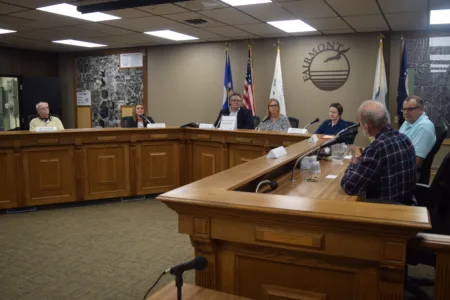
FAIRMONT - Candidates for Fairmont city council wards, as well as for state house and state representative, took questions from the organizers and the people in the crowd during the second candidate forum at the Fairmont City Council Chambers on Wednesday.
Each candidate had one minute to answer questions presented. If a candidate wanted to rebut an answer, they had two opportunities to do so.
For ward one, the candidates are Bruce Eastlund, Tabitha Johnson and incumbent Jay Maynard. For ward three, the candidates are Hollee Klesh, incumbent Randy Lubenow and Edward Paschke.
On the Local Option Sales Tax (LOST) money, all of the candidates approved of spending the money for a community center-type facility. Lubenow extended a little further on what some pieces of the full funds could be used for.
"I also propose that we use $2 million of that money towards our lakes. We’ve already used, I believe, $150,000 in Amber Lake for those docks. There, the problem is, is that our lawyers are very uncommitted to what we can use the money for, and until we know what we can use the money for, it’s hard to make a decision as a council member."
On what the city can do for rural health, Paschke and Klesh said there are already services that help with some of these problems. Klesh took it a step further, asking how the city can partner with these organizations to better support them, a lot of which are supported by volunteer workers. Lubenow said he had a granddaughter born, and she was born in Blue Earth because there is no one to deliver babies in Fairmont.
"That has to change," he said. “I’ve talked to a member of the hospital board. I’ve talked to Windom Health, talked to UHD. We as a city need to be supportive of anybody that wants to come to Fairmont and be able to do surgeries, deliver babies."
On building in Fairmont, Maynard said the charter says they cannot control hiring or firing, so all they can and should do is fulfill the council's role, to set policy for the city. Eastlund said there could be better communication, but he has talked to contractors who have had problems and those who have had no problems, and that the city building inspector is protecting the city, as something that is built wrong or not up to code can hurt people.
Johnson opted toward reform for permitting and building code, stating that they have to see why other cities are growing with their permitting and building codes, while Fairmont is not.
On what wards three candidates think are the two biggest issues, Klesh and Lubenow said lakes, Klesh and Paschke said housing and Paschke and Lubenow said business.
All candidates were asked whether they would follow the code of conduct as city councilors. All six said yes.
Maynard admitted he had been censured in the past and he has apologized and moved on, while he feels others have not been able to do so. Eastlund said he feels like there is a difference between the code of conduct written and what has been followed by the council the last four years. Klesh said that once the council comes to a decision, even if there are still differing opinions, all council members should work together and commit themselves to the decision that was made.
On the state house and representative sides, incumbent Republican Bjorn Olson and Democrat Sonja Denn are running for state house seat 22A, while Republican Jeremy Munson and Democrat Marisa Ulmen are running for the open state senate seat 22 being vacated by Rich Draheim, who is not seeking reelection.
The first question was one that saw immediate division, Minnesota Paid Family Leave. Ulmen and Denn spoke in support of the program. Denn said, as a human resource manager and director of finance for a small construction company, she has seen firsthand how huge a benefit it has been for small employers, large employers and employees.
Olson and Munson were not thrilled with the program. Munson said there are already hundreds of employers that have similar programs, and if it is a benefit that is important to people, employers can differentiate themselves using said programs to attract talent. Olson said there are areas like schools and hospitals where people cannot easily be replaced. Denn used one of her rebuttals on this point.
"This is not just something that can be willy-nilly," she said. "You have to have doctor documentation. It is pretty invasive as far as to prove your medical need for this coverage. It costs so much more money for me to go out and hire somebody without the experience who hasn’t been trained as the employer than it does to welcome back somebody. Many companies can’t afford to have these benefits without it. Just because I’m a small employer doesn’t mean that my employees deserve any less than a large employee."
In the case of $90 million in long-term care benefit costs being shifted from the state down to the counties, both Munson and Ulmen said they lacked specific knowledge, but it is something they both strongly disagreed with. Olson said it reminded him of the 2023 budget in which $900 million dollars was shifted in unfunded mandates, while Denn said the state cannot control right now how much facilities and companies charge, and there needs to be a resolution because healthcare is a need.
On the issue of fraud, Denn said there needs to be outside investigators when there is suspicion of fraud, like how they handled potential cases of fraud when she worked at an insurance company. Olson spoke on the new Office of the Inspector General at the state level to look for fraud.
"We need to do something," he said. "We need to continue to root it out every single day. You turn on the news, and you hear of another scheme, and you say, 'I can’t believe that somebody just fooled them that badly. It’s an embarrassment.'"
Denn then used her second rebuttal, stating that everyone wants fraud gone, but Minnesota is being made the scapegoat and put on public display, when other significant red states have more fraud than Minnesota.
Ulmen agreed and said fraud is a big enough problem without exaggerations. She said when fraud happens, it is not benefiting the end users of programs affected by fraud, but companies that are committing this fraud, and programs that are cut end up affecting the working poor who rely on government programs.
Munson said of $250 million in Child Care Assistance Program funds that were investigated by the Office of the Legislative Auditor, half was fraudulent, and a large portion of the other half was abuse.
"You’re not taking money from people," he said. "If you cut off half the money that’s going to fraudsters, you’re not hurting families because there is no person on the other end. Much of our healthcare dollars are also going to people that don’t exist. They’re just made up names on paper."
On what the biggest issue is besides fraud, Olson said affordability with tax increases and cost shifts. Denn and Munson agreed it's healthcare costs, but while Denn spoke in favor of Minnesota healthcare for all, Munson said the solution is competition in the marketplace and transparency. Ulmen said rural healthcare support and healthcare options.
A forum with Brad Finstad and Jake Johnson was also scheduled to take place, but neither candidate could make it.