
Ethics, AI head historical society speech
Trending
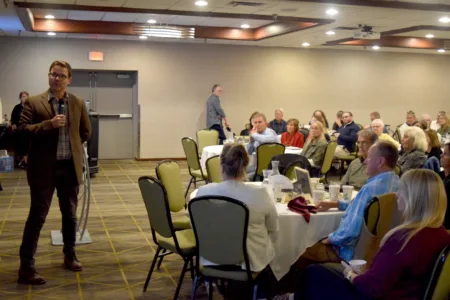
FAIRMONT - Michael Thate, a 1997 Fairmont High School graduate with time spent at Princeton and George Washington University and who's currently at MIT as a McDonald Senior Distinguished Research Scholar, gave the featured speech at the Martin County Historical Society (MCHS) Annual Meeting on Thursday.
Beginning the meeting, MCHS Executive Director Lenny Tvedten said their overall revenues increased by $169,367, and work has been humming along.
"Some of the major projects are completed," he said. "We had to do some restoration on the museum facade, windows, elevator shaft and the interactive room. If you haven’t had a chance to see that, just stop in and see it. It’s turned out to be really good, very interesting, both for children and adults."
He also mentioned some of the events that the historical society has been involved in, including filming for the documentary Nolte 36 and doing off-site historical presentations, one of which was on Martin County Native Americans for Fairmont High School Students.
To start off with, Thate said that out of the 170 students in his graduating class, he was around 130. After school, Thate spent 1997 to 2012 in a state in which he said he disappeared for a while.
"I didn’t really know what school was for," he said. "I thought, 'I’m just going to get a backpack and disappear.' I lived in the Himalayan mountains. Tried my hand with hanging out with the Buddhist monks."
After emerging from his journey to pursue a PhD in Near Eastern history and finding it was more of a hobby, Thate went into brand research. This, in turn, inspired his pivot into ethics and engineering, which he began working on at Princeton.
While there, two incidents spoke to him, one in ethics and one in engineering.
The first was a student who spoke with Thate after receiving an internship at Goldman Sachs. She sought advice from Thate on the ethics of staying in the internship due to its coveted status or leaving on principles and ethical concerns after news broke about Goldman Sachs’ involvement in the 1MDB scandal.
The second was an engineering student who asked Thate about the challenge of not having sovereignty over how their time is used, needing to work to solve other people’s problems to keep funding.
"I thought, I have no idea what I’m doing anymore at Princeton, and I want to feel that pressure and that stress in the wild," he said. "I have all these highfalutin ideas, but I actually want to be forced in some really icky situations, and my faith and my ethics actually can hold bare."
For 18 months, Thate worked in Washington, D.C. He sought work on lethal autonomous weapons systems, and ended up working on a prototyping group for electromagnetic pulse systems (EMPs).
"I thought if this is the place of most compromise, I want to be in the dirtiest, darkest possible room and try to inject a little bit of good," he said.
Thate then spoke on influences Martin County had on him, like a Folgers can experiment he had in fourth or fifth grade, when Tvedten was his teacher.
"A lot of people are losing their mind, oohing and ah, thinking Mr. Tvedten is the coolest thing ever," Thate said. "Some of us are just like, 'Yeah, this is basic, this is just stored energy transferred to a coil.' There are mysteries outside of our capacities as humans and mysteries within us, both in terms of sets of infinities, and that’s what has always compelled me: is exploring those sets of infinities."
The subject then pivoted from Thate himself to his topic of the evening, AI and its potential effects on education. Thate framed it as a question: Is AI the end of education?
"The answer to that question is yes, if we let it," he said. "We have to remind ourselves that these are humans building these. They’re distributed teams, which makes it kind of tricky. Anyone ever worked with teams? It’s the choice architecture there and the ownership of ideas. It’s pretty ambiguous, pretty quick. That’s what we’re working through."
Right now, Thate said every institution is over-leveraging on cognitive economy, and they are all terrified of AI.
"We have this wonderful tool that can game theory optimize and solve every cognitive challenge," he said. "This is the world we build for ourselves because we can’t handle the world that we’re living in. The question then becomes, how does one transform? This is where I get really excited about what Fairmont can do and what Martin County can do."
This transformation, according to Thate, is the educational experience from just the brain to the whole person. Jumping off of this, Thate discussed reward hacking to better motivate educational experiences.
"Why not have that first task of the day to be something simple like watering a plant?" he said. "Not an expert here, but whatever that is that starts tricking the brain into, 'Oh my gosh, I just accomplished something.' This is an addictive feeling. Instead of sitting down all day doing cognitive skills training to do well in the tests so that our schools could look better, we give finishable tasks that students start early in the day and start accumulating throughout. It’s just a brain hack."
Thate finished his speech by summing it up as the cognitive, which the education system has worked to measure for the last 45 years, has been mastered by machines.
"What we failed to measure: character, curiosity, care, is what our children have needed all along, and this is the room, this is the place to do it," he said. "These are some of my favorite people in the world, the most character-strong people in the world, and I am so excited about the future."