
Gleam WMA dedicated near Truman
Trending
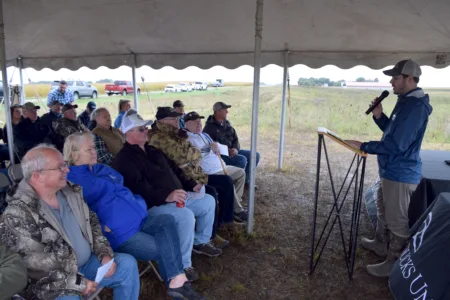
TRUMAN - With the Minnesota Department of Natural Resources (DNR) celebrating 75 years of wildlife management areas (WMA), the Gleam Wildlife Management Area in Truman received a dedication on Saturday.
The dedication came as Ducks Unlimited, Fox Lake Conservation League, the Minnesota DNR, The Conservation Fund and major donors were able to restore more than 51 acres of wetlands to the WMA, overall expanding the WMA to 293 acres.
DNR Area Wildlife Manager Brian Nyborn said it started as 25 acres in 1972 and stayed that way for around 50 years. It has since grown rapidly to 293 acres under wildlife management now, thanks to multiple land purchases.
Ducks Unlimited Regional Biologist Jake Chronister said this is a dream come true.
"For a kid like me to be restoring wetlands on the prairies where ducks need it, and then be able to come back here and celebrate with everyone," he said. "Overall, this project cost about $2.2 million, starting in 2017 with their first small purchase, Fox Lake, all the way to what we restored to the grass seed. There was three separate land purchases."
To do so, Chronister said it included pulling 12,000 feet of plastic drainage tile and further clay and cement tile from before the 50s that was crushed and mixed back into the soil.
Ending his speech, he said the wildlife has been incredible thanks to the work that has been done.
"There were reports of river otters," Chronister said. "I haven’t heard of river otters in southern Minnesota anywhere else. There’s sandhill cranes nesting out here that first year. The swans are still here. This spring, I came by just that first weekend in March when it started to warm up, and there were 5,000 speckle bellies behind me, bunch of snow geese. Two weeks later, there were 10,000 ducks."
Next up was Tim Eisenmenger from Fox Lake Conservation League. He said teamwork was crucial to making this possible.
"The best thing we ever did was when we joined up and we got with The Conservation Fund and Ducks Unlimited," he said. "They know how to do the restorations, do them right."
Eisenmenger also spoke to the qualities of the land, and how it was now back to what it was meant to be.
"When I looked at the abstract, in 1931 the family went bankrupt that farmed this, in 1935 a family went bankrupt, in 1981 another family went bankrupt on this farm," he said. "It never should have been farm. When you get to put a pump in and restore stuff like this. This is what it should be."
DNR Southern Region Wildlife Manager Joe Stangel gave some background on the 75th anniversary of WMAs and how it all got started.
"The WMA system started in 1951 with a program called Save the Wetlands," he said. "That’s when there was an extreme amount of wetland drainage happening, and it was an effort to protect wetlands and keep them from being drained and farmed."
With the Gleam WMA, Stangel said the moral of the story is you can't give up on them.
"Sometimes they sit there for years and years and years and nothing happens," he said. "Throughout the years, there’s always temptation to sell off these small tracts because nothing has developed and it doesn’t look like they’re going to develop. This is a great example of where local partners and national partners can come together and make things happen, create better access, better habitat around these small isolated WMAs."
Closing out, Area Conservationist Doug Hartke of Martin County said it has been around 11 years since the work with Lessard-Sams Outdoor Heritage Council began. Up to now, around $25 million dollars in funding has been secured and used for wet and dry land habitat projects spanning 2,000 acres.
The drive to secure land for wildlife continues, with Fox Lake Conservation League having closed on two additional parcels of land right now and a third in the near future.
"There will be additional things happening in the future in Martin County," he said. "We’ve got a great coalition. Martin County Conservation Groups work together."