
Solar project moving forward in Martin County
Trending
FAIRMONT - After weighing local opposition, the Minnesota Public Utilities Commission has approved the Lake Charlotte Solar Project in Martin County, and it is moving forward.
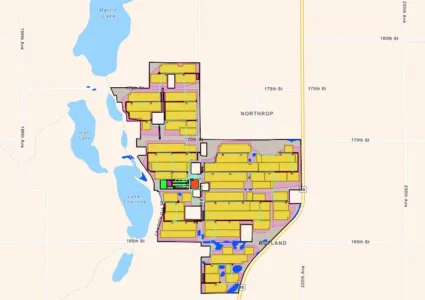
The project consists of a 150-megawatt facility and a 600-megawatt-hour battery energy storage system, from Geronimo Power and Lake Charlotte Solar, LLC. The solar panel array will be 662 acres in Rutland Township, while the project area as a whole is 1,276 acres. This area stretches between Lake Charlotte and Highway 15 and curls around Northrop to the west.
Plans are for construction to begin in the third quarter of 2027 and for operations to begin in the fourth quarter of 2029.
The project also plans to generate $358,000 per year in tax revenue, $287,000 to Martin County, and $71,000 to Rutland Township, for 30 years.
Throughout public comment periods in August 2025 and March 2026, this project has generated multiple concerns. These comments were posted to the project's official page. Jennifer Moeller, who lives near the suggested project, said in her comments that she is afraid it is too close to be good for people's health and enjoyment of the homes they have worked their whole lives for.
"We have seen recent stories of Solar Farms damaged by wind, hail and tornadoes," she said. "This has left huge messes in these communities and possible danger with water contamination. Why would we want this here in our County and neighborhoods?"
In another public comment, Morgan Johnson raised concerns regarding the project's scale, such as land use, environmental impact and its proximity to Lake Charlotte.
"The potential risks to local ecosystems, water quality and surrounding wildlife are significant, especially given how close this development would be to a natural water resource," she said. "Beyond environmental concerns, projects of this size can permanently alter the character of the surrounding area, affecting not only the landscape but also the people who live nearby and value this environment."
In total, 39 comments were sent in across multiple open comment periods.
Lake Charlotte Solar wrote a response to these public comments. Regarding impacts to farmland, they said it was found that the acreage for the project only constitutes 997.8 acres of farmland, which is 0.22 percent of cropland in Martin County.
"As a result, the EA concluded that the Project is not expected to have a significant impact on agricultural production in the County," Lake Charlotte Solar stated in their filing. "Applicants also conducted an analysis of potential alternatives to the site to avoid prime farmland impacts and determined that no feasible or prudent alternatives to the site exists."
Regarding potential environmental impacts, Lake Charlotte Solar said the risk of soil and water contamination is low.
"Each of the solar panel manufacturers being considered to provide panels completes testing for hazardous substances," Lake Charlotte Solar stated in their filing. "The manufacturers have confirmed that no hazardous substances are leached from the tested solar panel products resulting in leachate concentrations that exceed regulatory standards."
Minnesota Public Utilities Commission Environmental Review Manager Jessica Livingston said the project did have to make some changes as a result of public comments. This includes a visual screening plan required to mitigate visual impacts on residences adjacent to the project, as well as special conditions relating to noise.
Other concerns raised by the Department of Transportation for blowing snow control and the DNR for vegetation and wildlife were also addressed through lighting and dust control changes that require non-fluoride products, wildlife-friendly lighting and erosion control.
While these were unique for the area, Livingston said it was not out of the ordinary for changes like this to happen to a project.
"The location next to the lake was particularly of interest for the public, so that’s where some special conditions for water came out of," she said. "It’s not uncommon for solar projects to be located next to things like that, so not necessarily new for the PUC."
Martin County Commissioner Billeye Rabbe, who serves the Rutland Township area, said they have been meeting regularly with project representatives. Rabbe said she has heard optimism from those giving their land to the project, and the unhappiness from those who do not want to have solar panels near where they live.
Ultimately, Rabbe said the county board's rules don't apply because of the size of the project and it going through the Minnesota Public Utilities Commission, and the county board was not consulted about whether it should happen or not.
"My role has been a feeling of helplessness," Rabbe said. "You try to figure out what you could do, but there was nothing you could do either way. There’s people that think this is a good thing, and there’s some people who think it is not. There are both sides. It makes you wonder what leadership role you have as far as the county is concerned when, and I use the word power very cautiously, but you have no power. The power is taken away."
The next step for the project will be a pre-construction review process, where Lake Charlotte Solar and Geronimo Power work with the PUC to file compliance documents before an official meeting is set up between project officials and the PUC.
For more information on the project, visit puc.eip.mn.gov/web/project/16339.