
Robotics to share knowledge from college programs
Trending
FAIRMONT - After attending a Train the Trainers Program at MSU Mankato, Fairmont Robotics will be presenting what they learned to everyone, including attending educators.
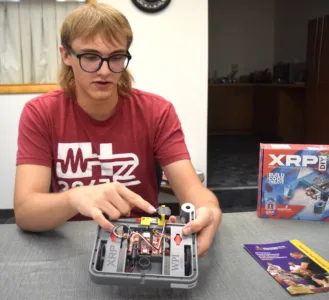
The program was put on by Minnesota's Rural Experiential STEM Education Partnership Initiative (RESEPI). For attending the program, Fairmont Robotics received 20 eXperiential Robotics Platform (XRP) robots, which are part of an initiative to make robotics education less costly and more accessible.
"Most robots the elementary school uses are $500 per robot, $1,000 per robot, which makes it really hard to get a lot" sophomore Hannah Gries said. " These are only like $100 per robot. Every piece besides the motors and electrical stuff is 3D-printable. You can 3D print any pieces, whatever you want to use our robot for."
The robotics team has been working with these robots for about a year before this educational event.
"We’ve showcased it at some of our events when we did our VEX IQ tournament in April," junior robotics participant Elias Monroe said. "We showed it to the STEM coordinator at the elementary school, Tiffany Harris. She said it was really nice. We told her all the benefits of it being cost-effective and easy way to teach. She seemed really on board with it."
The Train the Trainers program was mainly for educators, but with the work and connections Fairmont Robotics has made, Gries, Monroe and senior Gabriella Thoeny were invited to attend as well.
"I got the contact of Travis Thul," Monroe said. "He works at MSU, and he’s been helping with this RESEPI program. I asked him, 'If there’s anything we can do to advance this XRP platform, we enjoy it and we love it.' At Fairmont, we don’t have a lot of STEM classes, so it’d be nice if we can try and get this implemented. He reached back at me and said, 'We’re having this event June 15th through the 23rd; it’d be nice to have you guys there."
For the first week, Monroe said it was mainly about absorbing knowledge regarding the XRP robots themselves.
"Learning about the platform, what the robot can do, the different sensors on it, the servo motor here, what kind of drivetrain it has and the different types of connectors on this board," he said. "Basically learning about what we can add to it, its capabilities."
With all that knowledge fresh in their minds, the second week had them apply their skills in types of competition.
"We had to get code ready," Monroe said. "We had to do an auto code, fully autonomous. We can’t touch the controller, and then driver-controlled code for this type of game we did."
Being able to attend an event designed for educators benefitted the Fairmont Robotics students, who are looking to bring more robotics integration into classes across the area, not just in Fairmont.
"We even talked to two educators at the event," Monroe said. "When they had downtime, and even at home when they weren’t at the event, they were constantly making a curriculum for the XRP robot, and that spoke to me in a sense that anyone can make a curriculum for this. Anyone can start working on this robot."
To that effect, Fairmont Robotics will be hosting a showcase of the XRP robots in collaboration with RESEPI at 10 a.m. on Aug. 28 at Fairmont High School, in the CTE area through door 23.
"The event will spotlight the XRP platform and how it is being used by students, educators and community partners to deliver hands-on robotics education throughout the region," Monroe said. "The August 28 event is a chance to share what the students learned, see the platform in action, and celebrate the continued growth of robotics education in Fairmont and other rural communities across Minnesota."
This will include a demonstration utilizing the robots and an unboxing showcasing the robot and everything that comes with one. The event will be free and open to the public. Fairmont Robotics hopes for strong educator attendance so that this information and the applications of robotics in education reach those able to act on it.
Through events like this and sustained work, Monroe said they are working to increase utilization of robotics in STEM in this area. Armed with everything they've learned over the summer, and 20 robots ready to be used, they will be kicking this initiative into high gear as the school year gets started.
"With the robots, you can have three kids working per robot manufacturing parts, coding, and strategy and piloting," Gries added. "Our goal is to be able to get them into classrooms and help kids learn coding and engineering and design."
"We’re hoping to see a lot of these kits implemented in the classroom, at least in elementary classrooms by next year," Monroe said.