
County murals restored, returned
Trending
FAIRMONT-- After several months of work and about a year of planning, the Martin County Courthouse murals are repaired, nearly restored and back where they belong in the third floor dome.
The murals, painted in 1906 or 1907 by Franz Rohrbock, were deteriorating and becoming partially detached from the wall. In 2024, the county had received a grant worth about $2,500 through the Minnesota Historical Society to have a conservation assessment done by the Midwest Art Conservation Center.
After more conversations, an examination was done on-site in December of 2025 by Conrad Schmitt Studios, Inc. (CSS) of the most damaged mural, called Peace.
At that time, the murals were said to be in dire condition and the county decided to go ahead with attempting to restore them. CSS, the lone bidder, was awarded the project in April of this year for $207,858.
While there was a contingency option in the event that the Peace mural, which was in the worst condition, couldn't be restored and had to be replicated, there is some good news toward the conclusion of this project.
"These are all of the originals. We were able to save all of them," said Danielle Szaro with CSS.
In May, mural conservationists with CSS, which is based out of Wisconsin, came to Fairmont to physically remove the four large murals. They were then carefully rolled up, put in tubes and transported to the CSS studio to be cleaned and repaired.
"They were taken down and cleaned of all of the varnish and repaint that had been put on over them over many, many years, with solvent and treatment," explained Christopher Szaro with CSS.
The murals were last known to be touched up in 2006, ahead of the courthouse's centennial celebration and the county's sesquicentennial celebration.
However, the mural conservationists with CSS said it appeared that several attempts had been made prior to touch up and reattach the murals.
"We found a few different types of adhesive on the back so they tried multiple times to emergency fix it," explained Danielle.
In addition to cleaning the murals, Beva, a conservation glue, was put on the lining that was attached to the backs of the murals.
"By doing that it makes them a little more flexible and just adds another layer of protection," Danielle said of the lining.
Putting the murals back on the dome walls took some extra manpower as each mural is estimated to weigh between 45 to 60 pounds. The process took about two days.
"We wanted to ensure that everything was fully attached," said Danielle.
She said the murals were incredibly brittle when they removed them and that while they're still fragile, they're easier to work with.
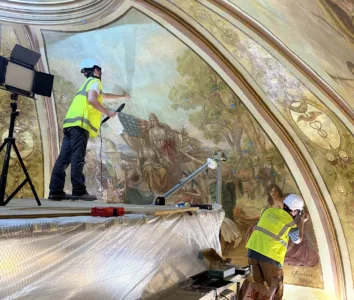
This week, with the clean and more structurally sound murals back on, restoration work has been taking place.
Right now there is a white fill material visible on spots that is used to create texture to match the original look and feel of the murals.
"The paints we use are incredibly thin and they paint more like watercolors and you can't feel that texture in them," Danielle explained.
The textured sports will be covered with a solvent-based paint carefully color matched.
Both Danielle and Christoper agreed that in conservation work the goal is to remove the look of damage while maintaining the artistic integrity.
It's expected that it will take about three more weeks to finish the work.
"It just takes time," said Christopher. "Because they'll be up for hopefully another 100 years."