
DNR checks boats for invasive species
Trending
FAIRMONT-- On Saturday members of the Minnesota Department of Natural Resources (DNR) were in Fairmont to do Aquatic Invasive Species (AIS) road check inspections on watercraft and trailers that passed by their set up at Gomsrud Park.
Chad Thesing, a conservation officer with the DNR, said, "what we do is set up signs on the road that say "check station ahead, water related equipment pull over" and they pull over into the area that we have cordoned off."
In this case, the Gomsrud Park parking lot right off of Lair Road was the area as Thesing said it was a safe pull-off area that sees a lot of boat traffic pass by.
As for what they were looking for, Thesing said, "zebra mussels, milfoil, boat plugs transporting water and things like that. The invasive species get transported around the state and move from lake to lake from typically boat trailers and water that people are hauling."
He went on to explain the importance of the inspections.
"All of a sudden lake A has zebra mussels and they transport water in their boat without pulling their plug and they get into lake B that doesn't have it. If the water comes out of it and into that lake, that lake can now get zebra mussels from the larva that's in the water and that's how that stuff gets spread from lake to lake."
To help check the different watercraft and trailers, several conservation officers were present, along with DNR ecological and water resources, level 1 and level 2 AIS inspectors that work in the summer. When they're not doing a road check, they'll be stationed at a boat access to check over and document certain things such as what lake a person was in last.
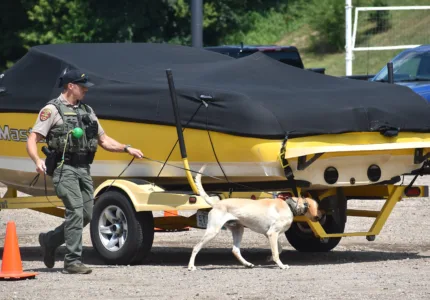
A specially trained dog was also on site on Saturday.
"Once they get into the inspection area we explain to them what's going on. We have dogs that are trained to sniff out zebra mussels," Thesing explained. "It's kind of hands-off. The dog walks around and sniffs. He's trained to alert if they smell the zebra mussels."
Once the dog indicates, an officer will move in to inspect and confirm what the dog found.
"Maybe they're smelling something that was there and is not there now or maybe they're smelling something that we can't really see, but once we take a closer look sure enough there's three zebra mussels tucked under the ridge of the boat," Thesing explained.
The dog, however, will not sense weeds so after a sniff check an officer will still look at the boat for weeds and boat plugs.
"Each of these processes take less than 30 seconds," Thesing said.
If at the end of the inspection everything is good to go, the person is sent on their way. If something is found, Thesing said it would be addressed with either a warning or a ticket.
This past weekend, Thesing said they checked about 18 different watercraft in four house and gave three warnings and three citations for boat plugs being in and weeds hanging off a boat or trailer.
In addition to the officers and the dog, there was also a decontamination unit on site so that if a bunch of material was found on a boat or trailer that couldn't be cleared off by hand, the boat or trailer could have a high pressure wash with hot water to get zebra mussels or weeds off to decontaminate it.
Thesing said they try to do 12 to 15 AIS road check inspections each year across the state.
"There might be one up in Baudette, one in Mille Lacs County, one in Brainerd. We try to do them in different areas," Thesing said.
He said a check has been done in Fairmont before but that it has been a few years since one was last done in the area.
"This was a prime spot. There's a pretty good amount of boat traffic and a safe space to pull them off. That's how we ended up with Fairmont," he said.
Speaking more to the importance of the inspection, Thesing said, "these lakes in particular don't really have any invasive species in them now so our hopes are to keep them that way."
He acknowledged that while the Fairmont Chain of Lakes does have Curly Leaf Pondweed, it is in most lakes across the state. Zebra mussels, however, are not in Fairmont's lakes. According to the DNR website, as of June 2025, zebra mussels are in five percent of Minnesota's lakes.