
Fairmont Speech brings home the gold
Yang earns first place at national tournament
Trending
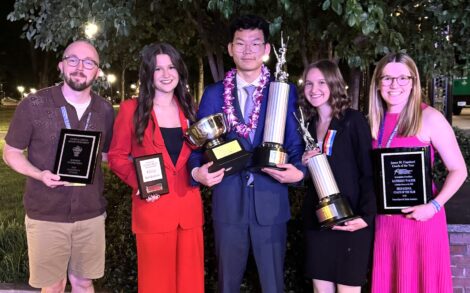
FAIRMONT - Against students from across America, Fairmont High School's Leon Yang became a national champion in Humorous Interpretation, and Fairmont as a whole was recognized as a top 20 school of excellence at the 2026 National Speech and Debate Tournament last week in Richmond, VA.
Yang, entering his senior year, was joined by 2026 graduate Bel Lutterman and upcoming senior Allie Streit. Lutterman placed in the top 30 in United States Extemporaneous Speaking, while Streit did not advance to the out rounds as a member of a WorldSchools Debate team, but was able to participate in supplemental speech events.
In an environment as high-strung as this, Yang said staying locked in meant practicing a lot.
"I really love practice," he said. "Not just during the nights, I would practice there, but during competition days, like an hour before the round, I would go and find a space, and I would just run my speech over and over again. I wanted to make sure that everything came with muscle memory, and so I can start focusing on flourishing my speech to adapt it to the audience."
In this practice, Yang said working on a humorous interpretation speech is similar to a one-man play.
"We work on it like how you would try to improve a play," he said. "We improve the characterizations, voices, humor and storyline. What was really important for me was telling a clear and moving story."
In all, Yang performed across 13 rounds of competition, whittling the field down from 270 of the best humorous interpretation speakers from across the country to just six by the final round.
Those six came from Oklahoma, Michigan, California and one other Minnesotan from Rosemount. These students were from larger schools. Both competitors from California came from James Logan High School, which has over 3,000 students across grades 9-12.
Yang had been to the final six before, finishing fourth place last year, which auto-qualified him for this year’s event. Going into the award ceremony, Yang said just making it to that point again was a win.
"Getting to the final round is the reward in and of itself," he said. "You get to share your speech on the biggest stage in the competition. Going onto that stage for awards, I was already very content with where I was. For placements, I wasn’t too worried about it. Whatever place I got, it wouldn’t have taken away from my performance that I did. That being said, I had a good feeling."
His good feeling was proven right when he placed first.
While Yang was performing in the same category he had the previous two years he went to nationals., for her final year, Lutterman changed from original oratory, which she had done the past two years, to United States Extemporaneous Speaking.
"The reason for my change was I felt what was being rewarded at the national level wasn’t quite what I wanted to do in oratory," she said. "That kind of the style we had taken on in southern Minnesota wasn’t one that was necessarily rewarded by the tournament and that judge pool, so I wanted a change of pace and see if I could do better competitively."
As a graduating senior, Lutterman said she saw two types of people at nationals who had just graduated: those who were excited to give it their best, and those who had somewhat checked out already. As one of the former, Lutterman reflected on her journey to this point and her final competition.
"I had already gotten what I wanted out of speech," she said. "A top 30 placement is great, and kind of the cherry on top to all the other skills and friendships I built through it."
While students had gone to nationals for speech before, 2026 was the first time a student, Streit, went for debate. Since they don't do WorldSchools Debate in Minnesota, Streit said it was really hard to learn, but it was her first time qualifying for a main event.
"The past two years, I was there for strictly the supplemental events," she said. "I had a lot of fun doing those, like putting together those pieces the past two years. This year, when I made the Southern District World Schools team through an application, I had a lot more fun. Obviously I like cutting big pieces for the supplemental events, but I had a lot of fun just learning the style of debate."
As he returns for his final season, a piece of advice Yang said he is looking to pass on is the importance of work with others and the self.
"I think it’s really important to work with your coaches, but it’s also equally as important to work on your speech yourself," he said. "I remember the first day of nationals, one of my competitors said, 'Yeah, last night was the first time I ran my speech in a month.' I was like, 'What?' I think it’s really important to obviously get that muscle memory in you and keep sharpening your speech."