
Courtland farmer attends National Ag Day celebration at the White House
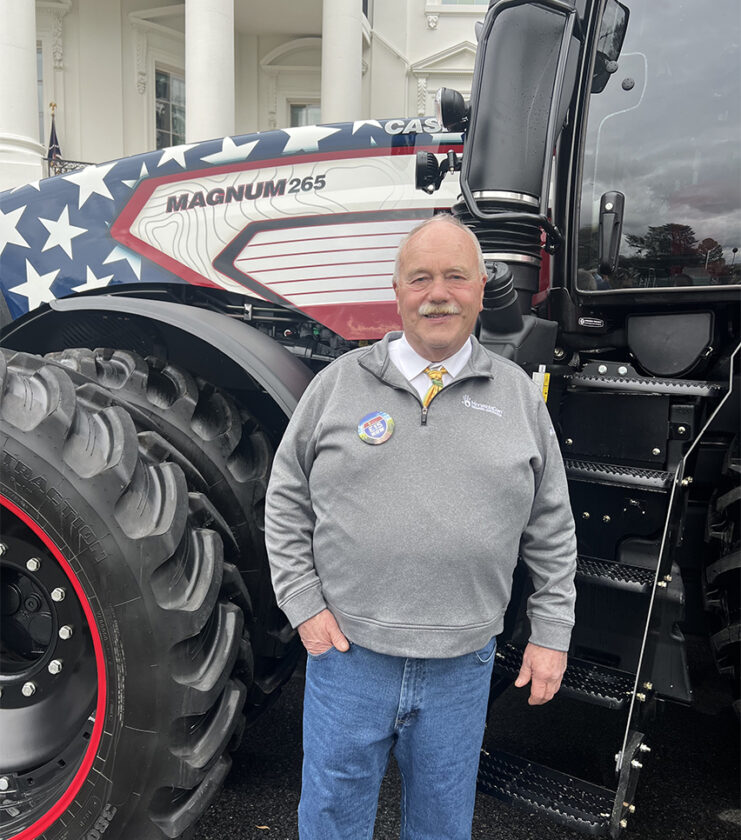
ABOVE: Tim Waibel, a farmer from Courtland, Minnesota, stands in from of The White House during a celebration of National Agriculture Day. Submitted photo
WASHINGTON, D.C.– The last time farmers and ranchers were celebrated at The White House was March of 1984, during Ronald Regan’s administration.
Founded in 1973, National Agriculture Day was brought forward to raise awareness of the importance of agriculture to our nation, often touted as the root of our nation’s economy.
Most recently, President Donald Trump invited agricultural industry representatives to The South Lawn of the nation’s Capital on March 24 to honor those that work within the vast industry of food production. From machinery manufacturers, to seed growers, to those that work the land, the invitation from The President landed in mailboxes throughout the United States.
Tim Waibel of rural Courtland, Minn., was one of those fortunate enough to have that invite extended to him. As a board member of the Minnesota Corn Growers Association, Waibel was more than qualified to represent the state of Minnesota and its farmers. Waibel and his wife Mary grow corn and soybeans and raise hogs.
“I believe there were approximately 300 to 400 people on The South Lawn of The White House,” Waibel said.
n general, Waibel was most interested in the ethanol industry and was pleased to hear Trump discuss the changes to environmental regulations regarding diesel exhaust fluid (DEF) and the estate tax that applies to farm and/or other business transfers.
Regarding ethanol, Waibel was supportive of the regulation of ethanol year-round, by the Environmental Protection Agency. Currently ethanol is only regulated in regards to the percent of the blend of ethanol to gasoline during the winter months.
“Minnesota leads the nation in blending of fuels,” Waibel commented.
For every one gallon of gasoline, a certain amount of ethanol, produced from corn, can be added.
“At the pump there are usually three nozzles. One will be regular unleaded, which is approximately 10 percent alcohol. E85 will contain 85 percent ethanol and regular-unleaded gas will be alcohol free,” Waibel explained.
He believes there is a benefit to the nation.
“Generally, production will be increasing nation-wide. First, ethanol-blended fuel is cheaper for consumers to purchase and is better for the environment,” Waibel said. “Minnesota is home to two refineries, located in the Metro.”
Those refineries process crude oil from Canada and North Dakota, turning it into gasoline and diesel fuel. The crude oil from Canada is tar sands; a heavy, viscous form of petroleum found in sand. North Dakota crude oil is lighter form than tar sands.
“Those types of crude oil require a lot of refining,” Waibel said when asked about the specifications of crude oil refining in Minnesota.
Ethanol does not require any refining, just the production of ethanal from raw corn.
Also mentioned by The President was the use of DEF in agricultural machinery. DEF is a non-toxic liquid used in diesel engines to reduce air pollution. President Trump believes the use of DEF in tractors is an unnecessary expense.
“We had a ridiculous Washington restriction called the Diesel Exhaust Fluid Requirement,” Trump said from the balcony. “It was a basic disaster. Today we’re announcing new guidelines drastically limiting these ridiculous DEF rules, saving farmers and consumers billions and billions of dollars.”
Trump also reiterated that it’s environmental nonsense.
“The tractor would turn off, if the computer thinks the tractor isn’t meeting environmental requirements. It’s too complicated,” Trump said
“I would like to see DEF requirements disappear,” Waibel said. “We had a new combine about six years ago that required three new DEF pumps; one right after the other during harvest season.”
Break downs such as that cost farmers in lost time, wages and repairs.
“People are switching to 700-horsepower tractors because those did not have a DEF requirement on them,” Waibel added. “It’s a God-send to have it disappear, because I always had to tote around large containers of DEF.”
According to President Trump, the cost of equipment should decrease with that change.
“Trump did say if we eliminate the DEF requirement, the savings should be passed on to the farmers and consumers. They should be the ones to benefit,” Waibel remarked.
Waibel was pleased to hear Trump discuss the changes to the Federal Estate Tax. This tax is detrimental when trying to pass the farm on to the next generation.
“That’s a big deal,” remarked Waibel. “The value of land has never been as high as it is now.”
In essence, when current owners pass away, any assets at more than $13 million is heavily taxed for consequent owners, making it nearly impossible for the next generation to take ownership. The valuation was set to decrease to $7 million at the end of 2025.
If a farm was valued at $8 million, the next generation would be required to pay up to 40 percent in taxes on the $1 million difference. If a farmer sells to the next generation, then he, or she, is required to pay the tax. The average farm size in Minnesota is 400 acres. Land is selling for up to $15,000 per acre.
Trump increased that valuation to $30 million per couple, a much more manageable number considering land valuations have skyrocketed. (The Estate Tax also applies to other business owners as well.)
“The Minnesota Estate Tax is what we will have to deal with now,” Waibel said. “The farm family will benefit as much as any other business owners will.”
The Minnesota Estate Tax sets the exemption at $3 million per person and taxes the assets at 13 to 16 percent on values exceeding the stated amount.
All in all, Waibel was thrilled to be at The White House representing farmers, ranchers and agricultural manufacturers in Washington, D.C.
Waibel said he was proud to be an American farmer and he is working at transferring the farm to the next generation.
“Prices are better than they were in 2022, but costs are up and the consumers feel it,” Waibel lamented. “Man, it’s expensive and I feel sorry for the kids that are trying to get involved. We need the Farm Bill to get passed. The House has moved on it, but the Senate has not done much. We need clarity in farming and The Farm Bill is our clarity.”
Local News

Welcome Historical Society to open Saturday
Courtland farmer attends National Ag Day celebration at the White House
New COVID variant appears as rates remain low
FAIRMONT – While COVID rates remain low, a new variant called Cicada has made its way into Minnesota. Public ...

Fairmont Christian School reaches independence
Strike Out Cancer on April 14
TRUMAN — As we celebrate Holy Week these are the following churches schedules: *Church of Christ will have a 7 ...
Briefly
MegaHertz completes Iowa Regional Robotics Competition FAIRMONT/CEDAR FALLS, Iowa — The Fairmont High School ...