
Colon health broken down for Martin County
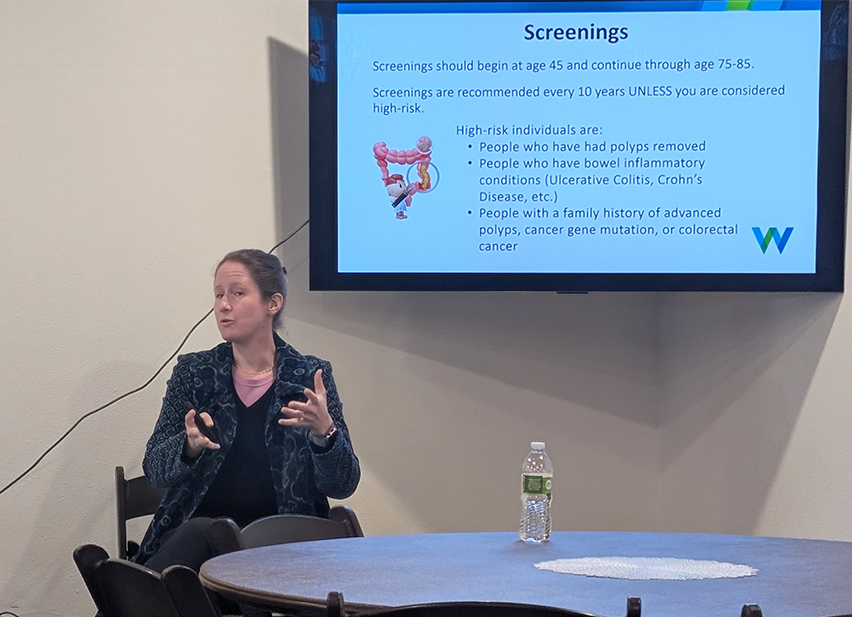
ABOVE: Windom Area Health’s Dr. Laura Grigereit discusses the process of screenings and recommended frequency of doing so during a talk on colon health at the Sinn Family Celebration of Life Center in Trimont on Tuesday.
TRIMONT – Colon health and what’s happening regarding it in Martin County were discussed at length in a free lunch and learn in Trimont on Tuesday.
The event was held by Windom Area Health at the Sinn Family Celebration of Life Center in Trimont and presented by Dr. Laura Grigereit. She started by listing some things that can help maintain long-term colon health, including minimizing your risk by staying up-to-date on check-ups, adopting a high-fiber diet with adequate hydration, regular exercise and avoiding tobacco and alcohol use.
“You can’t change the hand that life deals you in terms of genetics and the body that you’re born into,” she said. “You have some degree of doing your best to change it with diet. The biggest thing is increasing the amount of fruits and vegetables. Here in America, we tend to get plenty of protein, and it is hard to avoid delicious things like carbohydrates. In general, when we say increasing fiber, usually that means vegetables, some fruit.”
Not having enough fiber can also cause diverticulosis, which ranges in severity.
“Stool tends to move more slowly through the colon when you don’t have enough fiber,” Gigereit said. “That provides a chance for it to put pressure on the colon wall and create little pouchings or pockets. Those pockets are called diverticula. If they get irritated and infected, it can create diverticulitis. Sometimes we can treat it with antibiotics, sometimes you just stop eating your food that bugs you and it goes away on its own, and sometimes it needs surgery.”
Recently, Grigereit said there have been some headlines about colorectal cancer rates increasing, and those affected getting younger, which many have no doubt seen. She said this is indeed true.
“Is it because of chemicals that we might be exposed to in the processing of food or the growing of food?” she said. “Could it be things like microplastics within our food system and, frankly, everywhere? It could be many different things. It’s hard to know when it’s on a huge whole population.”
Currently, Grigereit said Martin County is around the national average in terms of colorectal cancer rates.
“We do know that southern Minnesota has a fairly high rate of colorectal cancer, even when compared to the national average,” she said.
Of those who get colorectal cancer in Martin County, Grigereit said around 34 percent of them were diagnosed at an early stage. This can be crucial, as 91.7 percent of those who get their colorectal cancer diagnosed early survive, compared to 54.9 percent of those who survive with late-stage colorectal cancer.
The recommended age to start getting colorectal cancer screenings is 45. Grigereit said this is relatively new, as it used to be 50.
“I anticipate it will get even younger within probably the next five to 10 years,” she said.
As long as there are no issues such as previous bowel polyp removals, inflammatory bowel conditions, or family history of advanced polyps, colorectal cancer, or cancer gene mutation, Grigereit said screenings only need to be done once every 10 years, until 75-85 years old.
The two main screening options, according to Grigereit, are a colonoscopy and Cologuard. While it is relatively new, a blood test called Shield can also help with screening. Guardant Health has recently partnered with Cornerstone Clinic to make this an option in Fairmont.
“We stay up to date on new developments in cancer screening, especially those that make testing easier for patients,” Physician Assistant Nathan Reyelts said. “We first learned about the Shield blood test when Guardant Health reached out to us. As more data became available showing its effectiveness, it stood out as a strong option to add alongside current colorectal cancer screening methods.”
It has been included for five months, and Reyelts said this addition has been successful and has been received well.
“The response has been very positive,” he said. “Patients appreciate that it’s a simple, non-invasive blood test, especially those who may have delayed traditional screenings like colonoscopies or stool tests. Our providers also see it as a helpful tool to improve screening rates.”
Overall, Grigereit said people should aim to eat vegetables at two meals a day to obtain 25-40 grams of fiber. Additionally, they should either avoid alcohol or consume it in moderation, refrain from smoking, watch for medications that irritate the digestive tract and stay hydrated by drinking enough liquids.
Local News
Cannabis 101

Center for Speciality Care’s Fairmont site closes
Colon health broken down for Martin County
Upcoming Easter events, services
SHERBURN — Watch out for people trying to fool you today. A CREST Lunch and Learn program will be at 11 a.m. ...
Briefly
Fairmont takes second in home meet FAIRMONT — The Fairmont High School (FHS) Speech Team competed in the ...
Powerful systems cause continuing temperature shifts
FAIRMONT – The past few weeks, temperatures have shifted drastically between warm spring-summer and ...