Bus law change felt by local bus drivers, educators
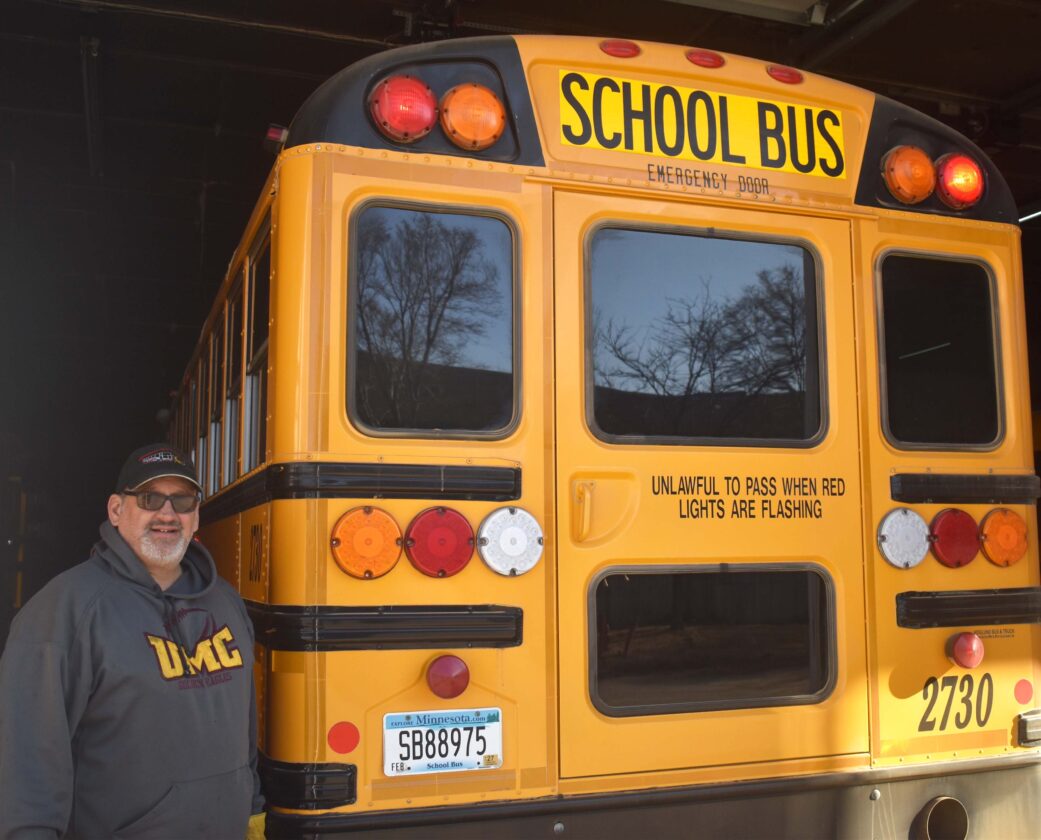
ABOVE: Minnesota Motor Bus Manager Dave Hurn comes around to check the flashing red lights on one of their school buses. A new law change will require motorists stop when a bus flashes their red lights, even if the stop arm isn’t out yet.
FAIRMONT – The Minnesota state house and senate unanimously passed a revision to the current school bus law, which will close loopholes and require drivers to stop sooner.
Representative Bjorn Olson, who was part of overseeing the bill as a Transportation Committee member, described what he had seen in loopholes through the previous version of the law.
“There was some court rulings that stated that the interpretation of the law was as soon as the swing arm was fully out, you were not able to pass a school bus,” he said. “What we’ve realized with cameras, a lot of buses have cameras on them now, people are getting away with passing buses because the swing arm wasn’t fully extended yet. As long as the arm was moving, these people were endangering children and getting away with it.”
The previous version of the law stated that as long as the red lights were flashing and the stop arm was out, people must stop at least 20 feet away from the bus. Now the flashing red lights, which come before the stop arm extension, are all that is needed to require stoppage of traffic.
An amended section has also been added that states vehicles approaching the pre-warning flashing amber lights are being warned that continued movement is to be terminated, and they must not encroach within 20 feet of the school bus when the red lights are on.
The bill passed unanimously in both chambers and is just waiting on a signature from Governor Tim Walz. As long as it is signed by Walz, the change will be effective the day after it is signed.
For Minnesota Motor Bus, which provides school buses for the area, they have been one of the companies able to use cameras to catch people breaking the law.
“We got a grant through the state to install two more cameras on the bus,” Manager Dave Hurn said. “It’s a forward-facing and a rear-facing camera on the bus, on the stop arm side, so we have a clear view of the oncoming traffic. We see the oncoming traffic and the traffic behind. It’s high-def. If we do have a violation, we can zoom right into the license plate, the make, the model. We have everything.”
Hurn had heard of this potential change for a while now. When he heard it had officially gone through, he said he was happy to hear it.
“It’s going to clean up a lot of the gray areas,” he said. “Because once the red lights are activated, there’s no gray area there. It’s going to be a lot safer. It’s the awareness. I know a lot of people that it hasn’t even dawned on them, ‘Oh, there is a new law.'”
Granada-Huntley-East Chain School Superintendent Doug Storbeck said this ruling helps strengthen GHEC’s highest priority of student safety by creating a safer environment for both students and bus drivers.
“By removing ambiguity about when a stop arm is extended, the updated legislation provides clearer expectations for motorists,” he said. “The law modification will enhance driver awareness and help protect our students.”
With the legislature making the closure of potentially dangerous situations like this a priority, Hurn said it is huge to see.
“They’re putting school safety above partisan politics,” he said.
Whether it’s through legislation or more education, Hurn said there is one area he would like to see addressed.
“I think some of the verbiage needs to be cleaned up pertaining to four-lane roads,” he said. “We do have a fair amount of those in town where we do stops on them. The only time [cars] are able to pass a bus with the red lights on is a divided highway. That means a [physical] divider down the middle of the road. We don’t have any divided roads in town. The misconception is that a lot of people will still keep coming in the opposite lanes on red lights.”
Local News

After 46 years, DeWar is moving shop
Area Easter egg hunts planned
CEYLON — CREST will host Toolbox for Caregivers from 9:30 to 11 a.m. each Thursday in April at the Sinn Family ...
Bus law change felt by local bus drivers, educators

Polar Plunge makes waves for inclusivity
Welcome Legion Fish/Shrimp Fry tonight
WELCOME — A Fish and Shrimp Fry will be from 5 to 7 p.m. tonight, Friday, March 27, at the Welcome Legion, ...