
UHD getting dedicated MRI expansion
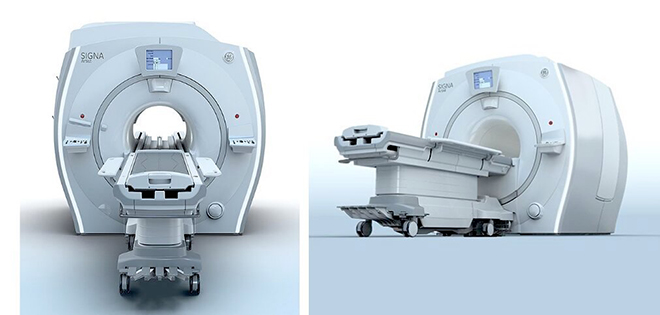
ABOVE: This machine will soon be added to UHD’s Blue Earth location for use in UHD’s network for patients, thanks to a $1.5 million gift from the Mike and Tami Hoffmann Family Foundation.
BLUE EARTH – United Hospital District (UHD) has received a $1.5 million gift from the Mike and Tami Hoffmann Foundation to expand its radiology department via a new MRI system by 2027.
Currently, UHD employs a mobile MRI system that comes twice a week. Medical Imaging Manager Jamie Shure said it can be uncomfortable for people with claustrophobia. UHD CEO Rick Ash agreed with this assessment.
“What this new fixed unit will be able to do is most patients will be able to have their MRI feet first,” he said. “Except for maybe some of the very head-type extremities, most of the time their head will be outside of the [machine]. For claustrophobic people, that’s a big issue.”
There’s also timing to consider. UHD handles over 110 MRI scans per month for patients that need them anywhere within the local UHD system. With the mobile MRI only available two days a week, backlogs have occurred.
“I remember when I needed mine,” Ash said. “It was two plus weeks out, and I didn’t know, do I choose to go elsewhere, or what do I do? For me, it wasn’t so much of an issue. If you’re worried about cancer or some of those other things, waiting is terrible.”
“We still are a couple weeks out,” Shure said. “It’s not very convenient. We’re always looking to improve patient care. With this, we will be able to give our patients a better experience overall. They’ll get in faster, get their results faster and get a treatment plan faster.”
While UHD had MRI on its mind for a while, Ash said it’s not a simple task.
“With all the other needs we have, we’ve got a 1960s building and things that there were other bigger priorities,” he said.
Ultimately, Ash said UHD Housekeeping Manager Darrin Germann had a chance encounter with Mike Hoffmann at a local restaurant, and it led to a meeting.
“Mike and Tami Hoffman stopped in, and we talked a little bit about our needs and our challenges,” Ash said. “Ultimately, I think the question was, ‘What are the things that you would like to do or need to do but aren’t able to do right now because of those other needs?'”
Without this support, Ash said he only has a ballpark estimate for when they could have afforded such an expense.
“The way things are going in rural health care, the challenges are anyway, there’s lots of need, and it takes a lot to keep the building in place and good staff,” he said. “We have to have good equipment. It probably would have been another 5 to 10 years.”
Thankfully, there is already space planned for the MRI, which was purposefully left empty when the facility was expanded in 2011. There is still plenty of work that needs to be done before it can be opened for use in 2027.
“It is just a shell space, so there is a lot of construction to do,” Shure said. “Getting the machine ordered and built, that’s another process that can take a long time. Up to six months just to get the system.”
Given the current challenges facing rural healthcare, Ash said having this donation will help them stay strong and viable for rural healthcare in this region.
“The whole United States rural healthcare system is in serious problems right now,” he said. “Our ability and commitment to wanting to make sure that our communities have the same level of care regardless of where they go, if they go to Mayo, go to the cities, we want to be able to provide that here. They deserve the same level of quality and service as they would in a large city.”
The current mobile MRI machine will remain available for any MRI needs two days a week until the new MRI machine area is finished.
Local News
Cribbage tournaments today, Valentine’s Day
CEYLON — Today is Valentine's Day. The cribbage tournaments continue with registration at 1:15 p.m. today, Feb. ...
UHD getting dedicated MRI expansion
GHEC moves on from four-day calendar
GRANADA – After opening Thursday’s Granada-Huntley-East Chain (GHEC) School Board meeting by choosing not to do ...
Still sweethearts after 75 years
School store helps students on both sides of the counter
Pressure patterns push area out of the cold
FAIRMONT – Martin County was in negative temperatures a few short weeks ago, but is now enjoying the comfort of ...