
Area schools getting students ready for life
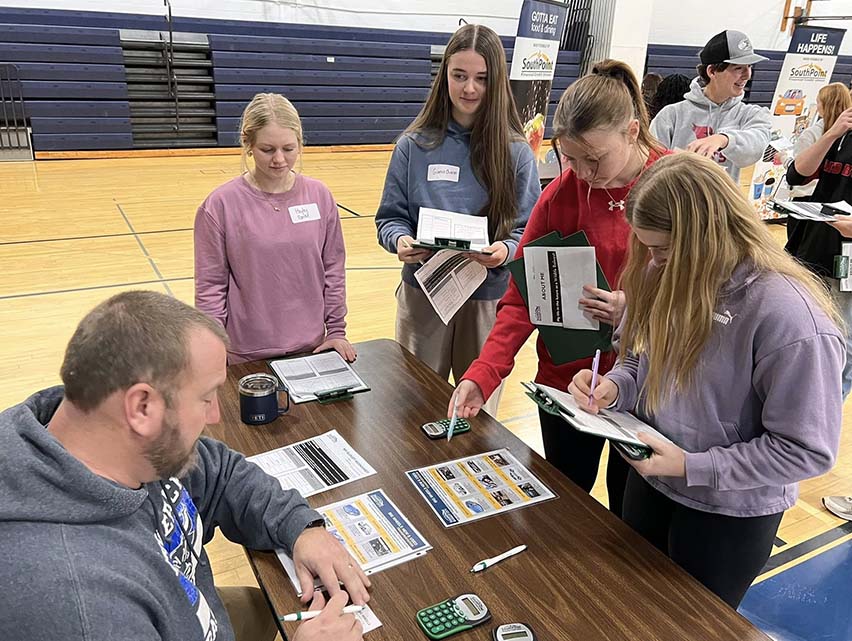
ABOVE: Martin County West students, from left, Hayley Clarke, Giana Chase, Mylee Larson, and Hannah Cole look through paperwork while getting assistance from a SouthPoint Financial representative during a Personal Finance class budget simulation. Submitted photo
MARTIN COUNTY – Across Martin County, schools are offering courses to help students with real-world tasks and responsibilities.
At Martin County West, Personal Finance Teacher Carter Wille said his class incorporates elements from their previous Financial Literacy course to meet the state’s new requirement that students pass at least one personal finance class.
“We cover life skills of how to manage your money and how to become a smart consumer of the current world,” he said. “How do you make a budget? How do you make good decisions when going to college? If you’re not going to college, what do you do then? Eventually, you have to be on your own, or at least make your own decisions.”
While the skills necessary to make it through life haven’t changed much over the past few years, Wille said how he teaches the students changes as he gets more comfortable with the curriculum.
“I’m pretty young still,” he said. “As I get more comfortable in the world of finance, I have a better understanding of how to teach it to kids. I bought my first home a couple years ago. I hadn’t done that before, so teaching it now is a little bit different now that I understand the process a little bit better. I use more project-based curriculum now requiring them to do the skills, actually practice the skills.”
It’s not just classroom learning either. Wille has been able to bring in experts to give students a crash course.
“Early December, we had South Point Financial Credit Union come in,” he said. “They’re based out of Mankato, Sleepy Eye and the St. Peter area. They came in and ran a budget simulation. They were given a set of circumstances. They had a job, family, kids and they had to go around and make financial decisions based on all that information. They had to buy a home, get a house, plan for a vacation, furnish the house, daycare, all that good stuff.”
Through this experiment, Wille said students learned what does and doesn’t work without having to do it the hard way in the real world.
“What some of the kids realized as they went was, ‘It’s not as easy as I maybe thought it was,'” Wille said. “Some of them went into the red, they went into debt, and they had to rethink some of their decisions; go back to the drawing board and find different opportunities or situations they could find themselves in. It was more of a living out what you’re learning kind of situation.”
At Granada-Huntley-East Chain (GHEC), High School Principal Andrew Walden said he has seen the rise in importance of life skills education.
“One of our biggest [things] we continue to hear is we need to get our students ready for the real world,” he said. “The real world might look different for some kids. Some kids go off to college, some kids go off to the workforce. The importance is when they graduate from GHEC, that we have them ready, that wherever their avenue goes, that we have equipped them with the tools for them to be successful.”
In addition to the personal finance class, GHEC offers a work program class where students can use class time to gain experience in the workplace and four food science classes, from meat science to farm-to-table. McKenzie Wagelie, who teaches these food science courses, said students are able to take what they learn from these classes and apply it at home.
“They are able to make meals at home,” she said. “There’s lots of kids who come in with varying levels and abilities in the food classes. The first couple weeks are getting to know their abilities and their comfort zone in the kitchen. Maybe they were a kid that baked all the time and just seeing where they are now, or maybe it’s a kid who just microwaved food only, now they know how to do basic skills in the kitchen.”
Walden said that life skills courses serve a great purpose, and with the building referendum allowing for changes and improvements over the next few years, they are exploring what could be added and improved for these courses as well.
At Fairmont High School, Principal Chad Brusky said teaching students life skills starts early with exploratories for their seventh and eighth grade students. This includes an art class and a STEM class, and it is an integrated, mandatory part of their curriculum.
“One thing we are looking at is trying to find a way to build in some social media awareness,” Brusky said. “Social responsibilities and how to protect themselves from online predation, whether it be financial or other ways, and understanding their own social footprint and the possible ramifications when it comes to finding work.”
Other life skills classes include culinary, personal finance, consumer math and cadet teaching for prospective educators. Through these and other programs, Brusky said they can be imperative for student interest.
“It is critical to some students just staying at school,” he said. “You’ve got to go to English or maybe a science class that you’re not overly thrilled about, but you still have the opportunity to take welding, take a class that’s going to prepare you for something you’re really interested in. I think that keeps kids in school and makes them make sense of why they’re learning some of the other things, makes it more real-world and applicable.”
As for upcoming opportunities, Fairmont just ran its registration process involving teachers who pitch new ideas. Brusky said there was some discussion around bringing back their principles of engineering and mechatronics courses.
“Feedback from the industry is that those are skills, like coding and how to think through a problem and use the materials you have in front of you to solve the problem, are highly desirable,” he said.
By offering these courses and life skill opportunities, Brusky said they want to sustain their ability to be responsive to students’ needs at a high level.
“We have more resources currently that we’re able to utilize,” he said. “The more we can be flexible and meet the needs of our kids, the more we’ll continue to be a place where students want to come, and families want to send their kids.”
Local News
Rollerskating planned at TPS
TRUMAN — Martin Luther High School will have a Mac and Cheese Cookoff from 5 to 7 p.m. on Friday, Feb. 6, during ...
Local parties reconvene for caucus season
FAIRMONT – The Martin County Republican and Democratic-Farmer-Labor parties each held their caucuses on Tuesday ...
Karson’s legacy shines in fourth Hoops for Heart memorial
TRIMONT — After the unexpected loss of 19-year-old Karson Kent Janssen to undetected myxomatous degeneration of ...
Area schools getting students ready for life
BE talks Senior Center meals
BLUE EARTH— A discussion on adjusting the lunch prices at the Blue Earth Community and Senior Center was held at ...
Welcome makes plans for wastewater improvements
WELCOME — During the Welcome City Council meeting on Tuesday, Bolton and Menk Engineer Travis Winter reported on ...