Every day different for area tow truck driver
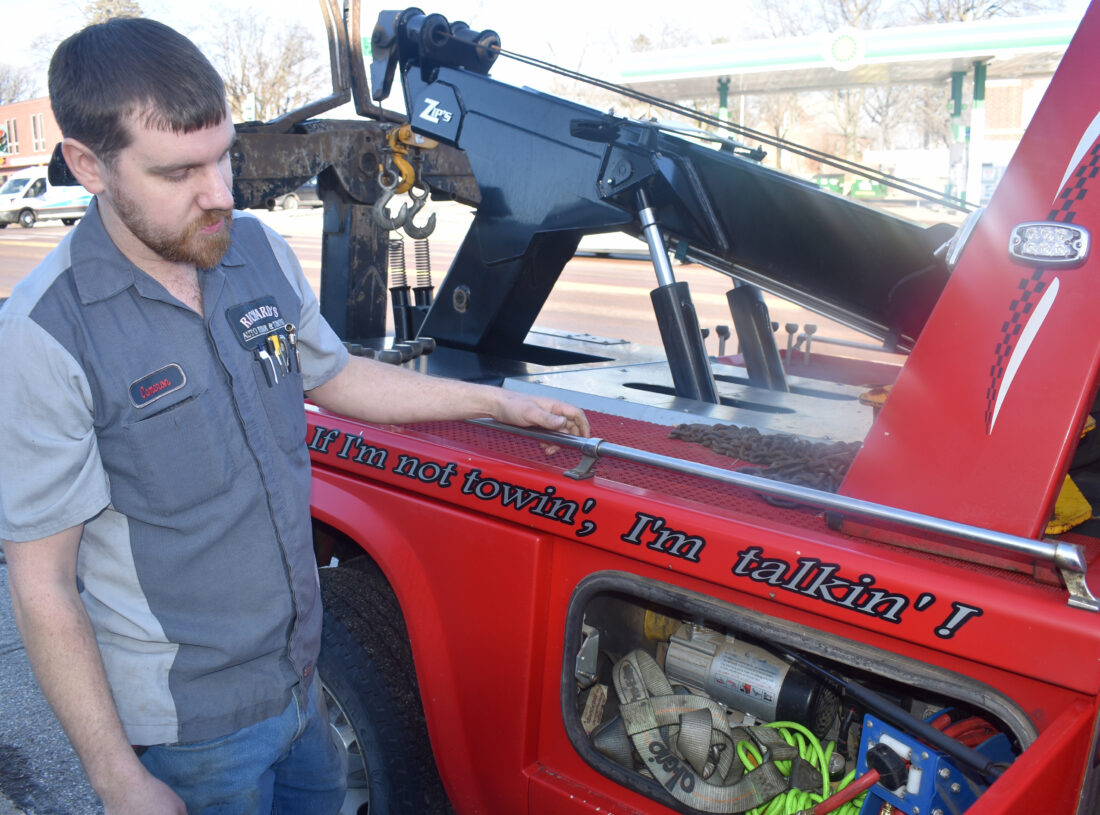
ABOVE: Richard’s Tow Truck Operator and Mechanic Cameron Meyer goes over just some of the equipment they have aboard their tow trucks to help people out of any sticky situation.
FAIRMONT – Given how harsh Minnesota winters are on cars, Cameron Meyer has seen firsthand what happens when emergency car care and rescue are needed.
Meyer has worked at Richard’s Auto Repair and Towing in Fairmont for 12 years, currently serving as both a tow truck operator and a mechanic. He said they try to do whatever people may need.
“We’ll go anywhere you’re willing to pay, where you need to go,” Meyer said. “If you need to get up to the cities, Sioux Falls, we’re willing to take you wherever you need to go. We do anything from jump starts, normal towing, tire changes, accident tows, [getting] you out of the ditch, any type of recovery we need to do.”
Depending on the year, Meyer said sometimes a winter season isn’t too different from the spring or summer, with the last two winters being an example. This winter, he said it has been slightly busier than previous years.
“We’ve had more accidents, more no travel advisory and stuff,” Meyer said. “People still go out, get stuck in the ditch, so we have to go out and get them. It’s been a little busier than the last two winters.”
Currently, Meyer said his days fluctuate in terms of call volume. Some nights he tows all night long, others he doesn’t have a single call.
“I’d say probably at 20 to 30 calls a week,” he said. “From your basic jump starts, flat tires, accidents, cars breaking down. It fluctuates so much.”
Because of this, Meyer said there is no average day in the life of a tow truck driver.
“There’s some mornings I wake up, I come to work, and I fix cars in the back,” he said. “All of a sudden, there’s an accident or someone calls. You go out, pick them up, take them where they need to go. You come back to the shop and start working after hours. I take the truck home every night with me so I can go home and continue on with my daily life. If the phone rings, you answer it, you go and take care of the people.”
Alongside this ever-changing schedule, Meyer said towing also comes with a set of dangers.
“You’re sitting alongside the road and hoping people flying by at 60 to 70 miles an hour are paying attention,” he said. “We’re working right on that line, right as traffic flies by you. We have all of our lights on. People are supposed to slow down and move over, but 50 percent of the time they don’t. They zoom right past it. You’ve got to always be paying attention, watching your surroundings and making sure people are paying attention to you.”
Thankfully, for situations where the tow truck might not be easily visible, they can call for police backup to ensure they are seen and safe.
Having been in the business for 12 years, Meyer said the biggest changes he has seen are the technological advancements within the tow trucks.
“You got backup cameras now,” he said. “Before, you didn’t have backup cameras, so you didn’t know how close you’re getting to stuff. They’ve got a wireless remote so you can run the winch line from the ditch. I can hook up to the vehicle and be standing there watching what’s going on while I’m following the vehicle out, rather than sitting up there on the side of the road not being able to see what’s going on.”
The trucks themselves are bought from the manufacturers directly, in Richard’s case, GM. Meyer said the truck is then sent directly to a factory, where it is installed with the wrecker body and any additional items requested. Richard’s most recent tow truck was bought one and a half years ago.
“We try to keep them for about four years, because usually then they get around 100,000 miles on them,” Meyer said. “They’re used daily, so they get wore out.”
Taking all of this into account, Meyer said he enjoys what he does day in and day out because he goes out and helps people.
“You’re saving the person’s day,” he said. “You’re helping them get to where they need to be. Holiday times, people break down. They’re trying to go see family. They think it’s the worst day ever because what are they going to do? They’re sitting alongside the road. They’re just devastated. If you can get out there and help people get to where they need to be, or fix their vehicle, get them back on the road, you feel like you accomplished something for the day.”
For staying safe on the road, Meyer said knowing your car and any potential issues is major.
“Maintenance on your vehicles is a major thing,” he said. “You need to make sure your vehicle is ready for the road, ready for road trips you’re going on. Pay attention to your tires. If you got a light on, take care of that. If the conditions are bad outside, and you don’t have to go somewhere, stay home. If you need to go out, slow down for the road conditions.”
*Editor’s Note: This article ran in the Sentinel’s Car Care section on Thursday, Jan. 15, 2026
Local News
Family Game Night on Friday at TPS
TRUMAN — The Jaguars girls’ basketball team will play tonight at Granada-Huntley-East Chain school in Granada, ...
Ceylon City Council makes appointments
CEYLON — The Ceylon City Council met on Tuesday evening and designated the following: Acting Mayor- Lon Oelke; ...
Every day different for area tow truck driver
BEA Board OKs Language Access Plan
BLUE EARTH— The Blue Earth Area School Board started off their meeting on Monday by electing School Board ...
Mattson, Emmert named GHEC Triple A winners