Locals hear about national issue, bill
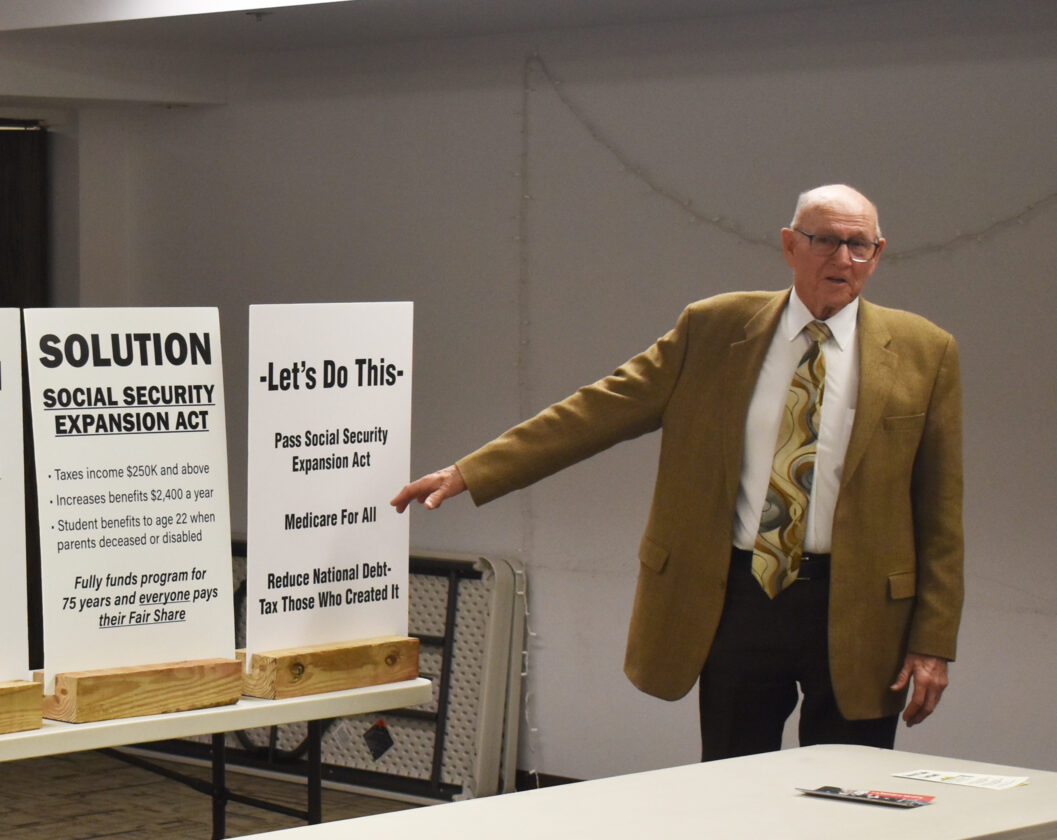
ABOVE: Touring Social Security speaker, Vote 2 Protect founder, and Minnesota Farmers Union member Brian Rohrenbach lays out his information and views during a presentation on Social Security and the Social Security Expansion Act Saturday at the Martin County Library in Fairmont.
FAIRMONT – Citizens braved the below-zero temperatures on Saturday to attend a presentation by speaker, Vote 2 Protect founder, and Minnesota Farmers Union member Brian Rohrenbach on Social Security and the proposed Social Security Expansion Act at the Martin County Library in Fairmont.
Before Rohrenbach spoke, Heaven’s Table was introduced and described, with a donation bowl provided for anyone who wished to contribute to the organization.
To start, Rohrenbach said the official title of Social Security is Old Age Survivors Disability Income.
“It’s an insurance program against the loss of income due to death, disability or old age,” he said. “Those are the only three things that will trigger a benefit. I received my first Social Security check when I was 12 years old, when my dad died. That was in 1953. At that time, it was $43 a month for survivors’ benefit, and a year later it was raised to $53.”
Throughout his life, Rohrenbach would continue to encounter Social Security even after he was no longer eligible due to dropping out of college. While looking into his brother’s severe stroke, which happened when they were 57, he found out his brother and their family were eligible for over $3,000 in benefits due to his being the disabled breadwinner for a wife and three kids.
When talking to a retired farm business management instructor, Rohrenbach said there was one thing the instructor always started his classes with.
“He told them to make sure they’re signed up in Social Security,” he said. “Farming being the hazardous profession that it is, [Social Security] is absolutely the best disability program that they will ever be eligible for.”
Once, while at the State Fair, Rohrenbach ran into two youths who thought Social Security would not be there for them and did not apply to them. Rohrenbach said this is a common misconception of Social Security.
“‘Are your mom and dad working today?'” He asked. “‘Yeah, they are payroll.’ ‘If something were to happen to the breadwinner, either be disabled or die, you would be eligible for survivors’ benefits right now. They didn’t know that, and they were happy to find out. That was the gratifying part for me.”
As part of the Federal Insurance Contribution Act (FICA), Social Security is collected on all W2 wages up to a $176,100 cap, with all money dedicated exclusively to paying Social Security Benefits. To date, this has resulted in a Trust Fund with a $2.6 trillion balance, which is invested in interest-bearing government bonds.
“The Trust Fund will be exhausted in 2033,” Rohrenbach said. “At that point, benefits are projected to drop to approximately 75 percent of the current benefit. It’ll be about a 23 percent reduction in benefits if nothing is done, if it’s left the way it is.”
Even so, Rohrenbach said under the current system, Social Security would not go away because money for it is automatically collected via FICA taxes.
Rohrenbach then jumped into the Social Security Expansion Act (SSEA), which would tax incomes of $250k and above, increase benefits by $200 a month, and raise the student eligibility age to 22.
“Right now it’s age 19, as long as you’re still in high school,” he said. “If this is passed, the eligibility goes to age 22 as long as you’re in vocational school or college. It used to be until you were 22. It doesn’t require any budgetary appropriation to implement this entire program.”
Through this act, Rohrenbach said it would fully fund the program for another 75 years and ensure everyone pays their fair share to keep the program going.
To conclude his presentation, Rohrenbach moved away from discussing the details and stories regarding Social Security, FICA and the SSEA. He offered his view on where things should go from here, including passing the SSEA, implementing Medicare for All and reducing the national debt through taxation of the wealthy.
“I’m not advocating free care for all,” Rohrenbach said. “Everybody can pay something, and I don’t believe there’s any single thing that can be done to help stabilize the American families more than Medicare for All.”
Local News
Locals hear about national issue, bill
Council dives into allegations against Kawecki
FAIRMONT— The Fairmont City Council gathered on Monday for another special meeting, which was a continuation of a ...

Event connects Fairmont police officers, families
Ag2School softens GHEC tax levy increase
GRANADA – Though the official total is a 34.9 percent increase, Granada-Huntley-East Chain (GHEC) Superintendent ...

Snow makes local club rejoice