
Grant brings farming history to Fairmont
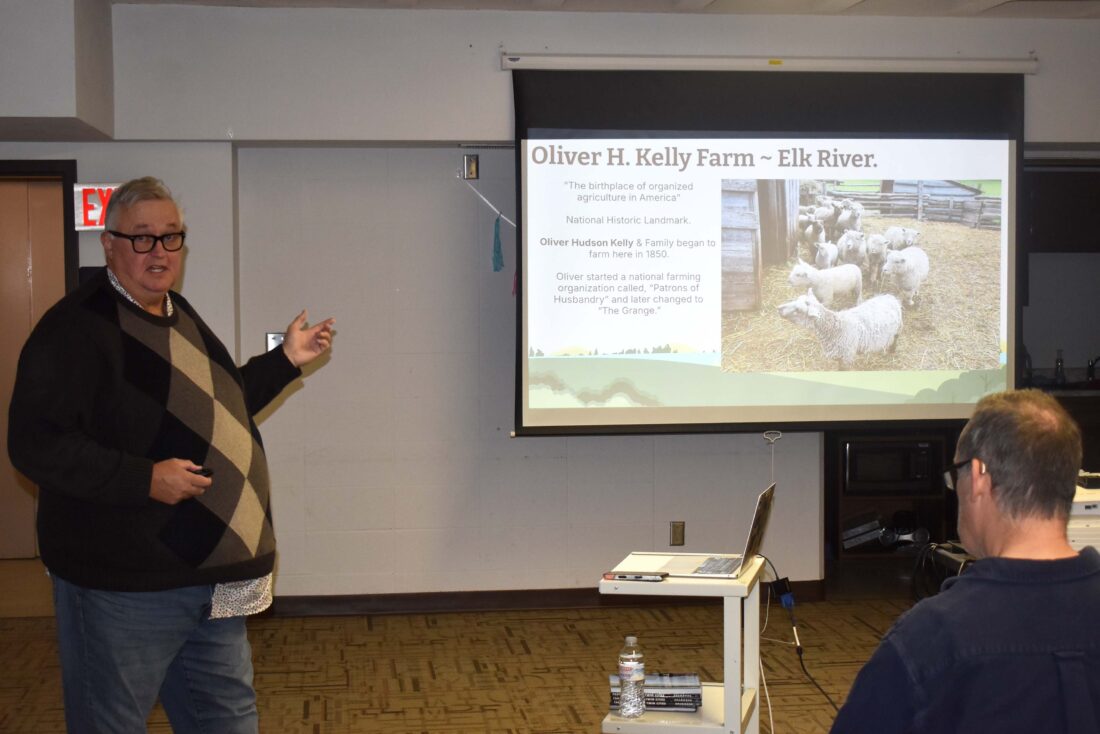
ABOVE: Author Jay Grammond speaks to the attendees of his talk on Minnesota’s Agriculture History at the Martin County Library in Fairmont on Friday. The talk was made possible through a grant from Minnesota’s Arts and Cultural Heritage Fund.
FAIRMONT – Thanks to a grant from Minnesota’s Arts and Cultural Heritage Fund, attendees got to learn about Minnesota’s farming past from Author Jay Grammond at the Martin County Library in Fairmont on Friday.
After working in adult enrichment for community ed programs for 20 years, Grammond made the switch to professional photography and writing six years ago. He said it was a leap of faith that paid off, as he gets to photograph pieces of Minnesota’s history and write about them for a living.
The Frank Schott farm in Chokio, Minnesota, is what opened the discussion. Grammond said Schott was a German immigrant who built a barn in 1923 that is unique in its design and appearance due to all of it being made with locally sourced materials. All of it remains today except for the roof, which Grammond said fell at some point.
In Elk River, Grammond said the Oliver Kelly Farm is considered the first place of organized agriculture in America and a National Historic Landmark.
“[Kelly] came with his family in 1850,” Grammond said. “He started off this organization called the Patrons of Husbandry, which later changed to the Grange. You probably recognize that name, the Grange. I learned about the Grange from watching Little House on the Prairie and Pa was always going to the Grange meeting somewhere.”
Stearns County is home to the Anton Gogala Farmstead, founded in 1867. The operation was run by a Slovenian-American family, who helped to found a village north of Albany named St. Anthony. The village started as a place for Slovenian-American settlers.
In trying to get photos of this place, Grammond said he bit off a little more than he could chew.
“I went to the house and wanted to see if I could take pictures before I started doing it,” he said. “Nobody at home when I was waiting for an answer, and I started looking around, and there’s huge cameras, security cameras, pointing right at me from all directions.”
Pivoting to Agricultural Pioneers, Grammond started by discussing Native Americans like Winona from the Dakota and Nawajibigokwe from the Ojibwe.
Winona symbolized the backbone of pre-contact agriculture, utilizing techniques like mound farming to maximize yields of wild rice and corn. Nawajibigokwe was noted as a skilled farmer and cook who both kept her community fed and worked with fur traders.
Grammond said he had been to a few of these sites recently for his next book, including an area where an old village had been. He said the distinction could still be made between where the village was and where the wild rice started.
Locally, Mary Ann Hayden was a homesteader in what is now Blue Earth County. She lived there from the 1820s to the 1880s, tending to a 10-acre garden, grinding corn by hand and preserving food. When the grasshopper plague hit in the 1870s, Grammond said Hayden improvised and planted crops resilient to the grasshopper plague.
Sarah Christie Stevens was next up, as Grammond described a single homesteader who cultivated an 80-acre plot.
“She cultivated bees and barley, raised sheep, used wool for trade and personal use,” he said. “Even built her own sod house, and then had to keep that for a certain number of years.”
Grammond finished his presentation with the accomplishments of Peter Gideon and Wendelin Grimm. Both men cultivated previously non-existent varieties of crops that changed Minnesota agriculture forever.
Grimm developed the first winter-hardy alfalfa, boosting the supplies for increasing dairy herds. Gideon made the Wealthy Apple, the first apple cultivar to prosper in Minnesota, and a precursor for the numerous apple varieties enjoyed in Minnesota today.
Local News

Those affected pick up pieces from Fairmont house fire

New MCW school starts to take shape
Helping Hands sponsoring Santa Day Dec. 20
CEYLON — The Our Savior's Lutheran Church will have an evening service at 5:30 p.m. tonight with communion. They ...
Grant brings farming history to Fairmont
Welcome City Council hears building plans
WELCOME — The Welcome City Council held its Truth in Taxation meeting on Tuesday evening. Several people ...
Imagine Martin invites all to explore holiday homes
FAIRMONT — Imagine Martin will host a Holiday Tour of Homes fundraiser, benefitting the Red Rock Center for the ...