
$72 million question goes to voters
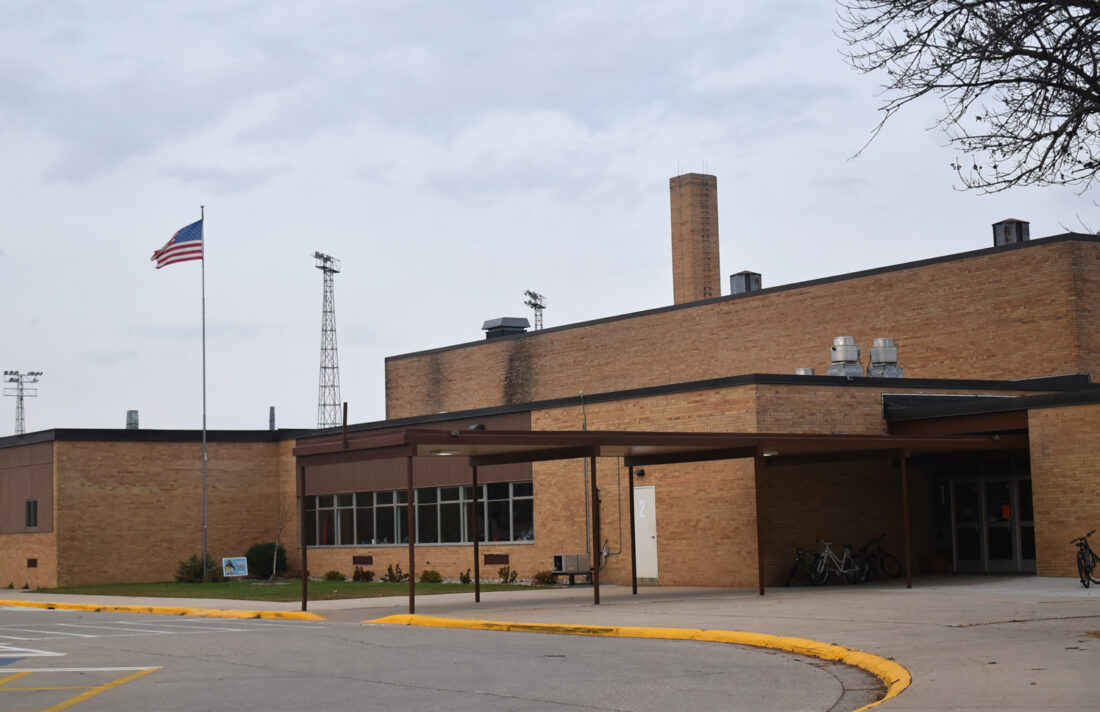
ABOVE: Martin County West High School in Sherburn. The district is asking voters on Nov.7 to support a referendum that would allow for a new school building, housing all students grades preschool through 12th, to be built on the this site.
SHERBURN– Voters in the Martin County West (MCW) School District will be faced with two important questions on Nov. 7. The district is asking the voters to consider passing a $63 million bond referendum to build a new school building that will house all students grades preschool through 12th, and a new auditorium and gym for an additional $9 million.
Superintendent Cori Reynolds explained how the district has come to be in this situation.
The district has four school buildings, but currently has students spread across three. Sherburn Elementary School houses those in preschool through 2nd grade, Trimont Middle School has 3rd through 6th grade, along with a few preschool classes and Martin County West High School in Sherburn has 7th through 12th grade students. The school building in Welcome has not had students in it for a number of years though it has been used for other reasons. Reynolds said at this point they’re waiting to have funds available to demolish it.
There are just under 700 students enrolled in the district and it employs about 130 staff members. These roughly 820 people are spread across the three buildings.
“The proposal is for a new school building for all of our preschool through 12th grade students. All kids, all staff under one roof,” Reynolds said.
She explained that there are three main drivers behind the project: the budget, the condition of the current buildings and the adequacy of those buildings to provide the education the district wants to give students.
“We’re taking care of more buildings than we can afford with the number of students we have,” Reynolds explained.
In speaking about the budget, she said the district has been functioning at a deficit for a number of years and the only thing big enough to change it is the buildings.
As for the condition of the current buildings, a survey done last year by ISG Architects and Engineers found that, between the three buildings, about $30 million is required over the next 20 years to bring the buildings up to code.
“It includes the roof and the plumbing and the site issues. they need to be brought up to code for accessibility,” Reynolds said.
A concern shared by Reynolds and the school board is that, while $30 million is a lot of money, the work done at that cost still wouldn’t do anything to address the third issue: the education adequacies of the buildings.
“I say a lot of times, we have too much of the wrong space. Spaces like our career and tech ed labs and classrooms are really undersized with low ceilings, cramped quarters and not a lot of storage,” Reynolds said.
She noted that the new robotics program has no space to meet at the high school and instead meets at a computer lab at the elementary school.
“We’re doing amazing things with Martin County West buildings, it’s just in spite of the buildings, not with the space we want. We’re also growing in ways the buildings can’t handle,” Reynolds said.
The elementary school building was built in 1969, the high school building in 1954 and the middle school building in 1959.
“They’re getting up there in years and they were built for a different time. In 1973, Title IX went into effect so girl’s sports became a thing that high schools had to offer. We essentially doubled the number of extracurriculars offered but the space didn’t change,” Reynolds said.
Prior to coming up with the current plan to build a new school building, the school board looked up options to expand one or two of the current school buildings. However, the cost of doing a heavy remodel and addition on one or two of the buildings was close to the cost of constructing a new building.
On Nov. 7, the voters will first be asked to pass $63 million for a new preschool through 12th grade school building, which will be located on the site of the current high school building. It will be 147,000 sq. ft. and will feature an eight lane track and football field, parking lot, several playgrounds, extra classroom space to allow for growth, five gym courts, cafeteria with flexible space for school and community events and more.
The $63 million includes the estimated cost that the architects and construction company have come up with for not only a new building, but also to equip the building, as well as money to demolish the current buildings. However, Reynolds said the hope is that the communities in which the current buildings are in can find a use for them.
“I’ve been in conversation with both of the cities to talk about the possibilities of how to repurpose the buildings. I think staff in both cities are thinking about that,” Reynolds said.
The second question on the ballot will ask voters to support a 400 seat auditorium and an additional gym onto the school for $9 million.
“The second question is contingent on the first one passing,” Reynolds said.
She explained that the second question was added to give voters some choice. She cited the community survey that went out in the spring, testing the concept of a one-building school and a one-building new school.
Reynolds said they received about 1,000 responses and that the idea of a one-building district was overwhelmingly positive, as was support for the building being new.
In the survey people could also select what kind of amenities they would like to see. While a track was most heavily supported, that’s included in the plans for a new school. One of the other things supported was an auditorium.
“At this point we don’t have great space for performances or speakers,” Reynolds explained
Currently the drama department puts on shows at the community theatre downtown and while Reynolds said they’re fortunate for that partnership, there are also concerns about accessibility.
As for the tax impact to the people in the MCW school district, those with a home valued at about $108,700 will see an impact of $235 annually and an extra $36 annually if question two also passes for a total of $271 annually. The bond is for 20 years.
“We’re estimating a 5 percent interest rate. We’ll know more when the bonds are actually sold but that’s a conservative estimate,” Reynolds said.
In the event that the referendum does not pass, the district will need to consider the issues that are driving it, which includes the budget, the condition of the buildings and how it can move closer to providing the education to students that it desires.
“Like any budget, when you’re in deficit mode, you can either decrease expenses and/or increase revenues. We’ll probably have to do a mixture of both,” Reynold said.
The district is limited in how it can increase revenues as the amount of money it receives from the state is dictated by the number of students enrolled, so Reynolds said they would have to look at asking the voters to support an operating levy.
“We have a current operating levy in place that expires in 2026. If this doesn’t pass, it makes sense to me that the school board would have some discussion about how that gets renewed,” Reynolds said.
Another thing that would need to be looked at is how to decrease expenses, which would include budget cuts. Reynolds said they would like to start as far away from the classroom as possible.
“We’d start with things like reducing our advertisements. So we wouldn’t advertise our job postings, which is difficult in a labor market like this when we’re having trouble getting teachers,” she said.
They would also look at walking distances and ask students who can walk to school to do so rather than having a bus pick them up. Extracurricular activities and athletics would need to be looked at and if some are dropped, that could hurt enrollment, which would mean less money for the district.
Eventually, Reynolds said they would need to consider things in the classroom. She said they currently offer art and music but they’re only required to offer one. They would also need to look at class sizes and teachers, which is something the school board hasn’t been interested in as it’s committed to small class sizes at MCW.
If the referendum passes, work would begin immediately, though Reynolds noted it would be a nine to 12 month planning process.
“We would hope to be on a schedule that allows us to open the doors to the new school building in time for the 2026-27 school year,” she said.
As for community response so far, Reynolds acknowledged that there are passionate people who have organized advocacy on both sides of the issue.
“There are passionate people who love Martin County West and want the best for it, but who have different opinions on what should happen,” she said.
Ultimately, Reynolds said she believes that common sense will prevail. She said the district has provided information and shared that about 12 community meetings have taken place over the last year.
“We have done everything we can to make sure that people know what is happening here,” Reynolds said.
There are about 2,700 registered voters in the MCW school district and about 250 have already voted early.
There’s a detailed report from ISG on the $30 million of work needed for the three current buildings on the school’s website. The community survey results are also available on the website at martin.k12.mn.us.
Local News
Coffee Lovers to meet each Thursday
CEYLON — The cribbage tournament will begin with registration at 1:15 p.m. today, Feb. 21, and at the Welcome ...

Fishing guides bring expertise and passion to area lakes

Speech swells with influx of new participants
Prairie Lakes added to MnDOT map
Welcome Legion cribbage tournaments Saturday
WELCOME — The American Red Cross blood drives will be today, Feb. 20 at the American Legion Hall in Fairmont, ...
Council will extend offer to city administrator candidate
FAIRMONT— The Fairmont City Council held a special meeting on Thursday to once again discuss the city ...