Groups strive for prevention, connections
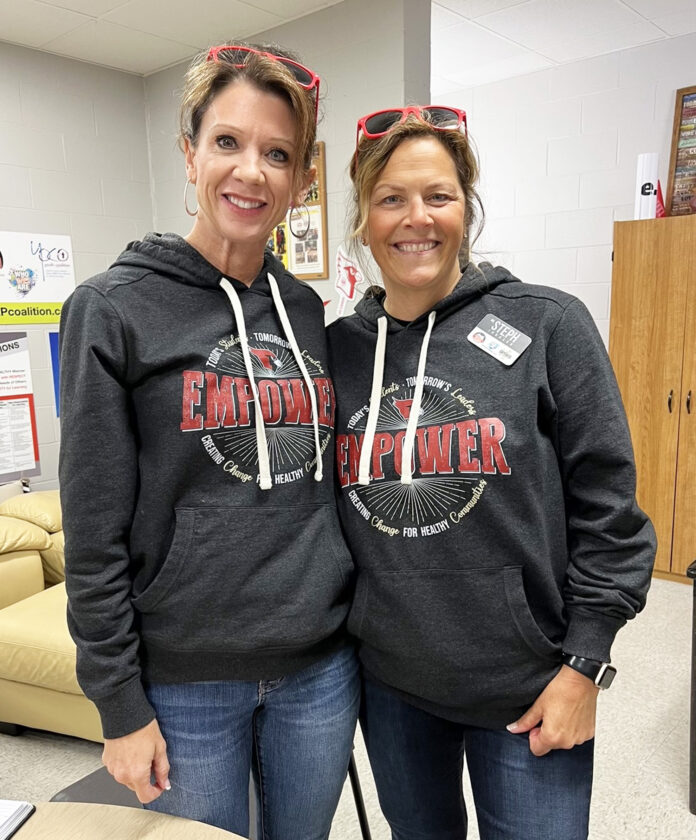
ABOVE: Shelly Larsen, left, and Steph Johnson, Project Coordinators for Martin County Substance Abuse Prevention (MCSAP) Coalition.
FAIRMONT– The Martin County Substance Abuse Prevention (MCSAP) Coalition has had a presence in the county for over a decade. It’s made up of community members who are dedicated to preventing underage drinking and drug use in the county.
The coalition meets on the second Tuesday of each month at the Best Western in Fairmont. Typically about 25 members attend the meetings, along with some students from around the county.
While MCSAP is the group for adults, there is a youth Empower group, formerly YOCO. All of the schools in the county have their own Empower group for students grades 7 through 12, which meet at least once a month, if not more.
Each school has their own Empower advisors. At Fairmont it’s Elizabeth Lowry. Truman’s advisors are Jim Utermarck and Cairne Eytcheson. At Granada-Huntley-East Chain it’s Kari McGregor and Karen Weets and Martin County West’s are Laura Ebeling and Heather Winter. Martin Luther’s advisor is Lisa Kube.
While Empower numbers took a hit during Covid like so many other organizations, numbers have recently been bouncing back.
“All of our groups are talking about how to get our messages out to everyone, not just our own group. That’s been one of our main focuses,” said Steph Johnson, Project Coordinator for MCSAP.
She pointed out that there are a number of positive and strong youth groups in the schools like FFA, National Honor Society and student council.
“As Empower we’re really trying to reach out and partner together more with them,” Johnson said.
This past summer, some Empower students and advisors attended a mid-year CADCA conference in Orlando, FL. MCSAP’s new Project Coordinator, Shelly Larsen, went, too.
“There was a youth track that the students participated in. They had the opportunity to meet other students from all over the nation that are involved in prevention work. That was a highlight for them,” Larsen said.
This coming Monday, the students who attended the conference will present about what they learned, and what they plan to do with it, to Fairmont Rotary.
At the end of January, Larsen and Renae Vetter, a new executive board member, will attend the forum CADCA meeting in Washington, D.C. There they will have the opportunity to speak to legislators about policies.
Johnson shared how thankful they are to have not only a strong board, but a community that supports their work.
“Shelly and I can’t be everywhere. It really takes everyone doing their part and being involved to be effective in our community… it’s nice to have community leaders advocating for our work,” Johnson said.
Since the start of the school year, Empower groups have been busy with a number of activities in their schools and communities.
In October an impaired driving event took place. For that they partnered with local law enforcement and Toward Zero Death (TZD). Impairment googles were available for people to put on which show what it’s like to drive under the influence of drugs or alcohol.
“We did it in the mall parking lot and we collaborated with Martin County Park Producers.
It was a very collaborative event,” Johnson said.
Soon after that, Empower groups in the schools led activities for Red Ribbon Week, a drug-abuse prevention campaign.
“It’s a great opportunity for them to talk about and bring about awareness of prevention and making healthy choices,” Larsen said.
Also this past fall, Fairmont Empower took part in a prescription drug take-back day at Hy-Vee in Fairmont. For that they partnered with the Martin County Sheriff’s Office. The event allowed for community members to drop off un-used prescription drugs for safe disposal.
Johnson said at that event they learned that there’s no other drop boxes in the county besides in Fairmont. There’s one at Hy-Vee, which is available select hours, and one at the Sheriff’s Department which is always available.
MCSAP is brainstorming ways to make safe un-used drug disposable more accessible. Larsen said they’re thinking about doing take-back days in other communities that don’t have drop boxes.
Recently, both MCSAP and Empower members had been researching and preparing information to share with various city councils about the need to come up with an ordinance regarding the sale of THC products.
“Our main goal was to keep kids safe and to reduce risks and keep any vendors or sales away from area where kids are at, such as parks, schools and sporting fields,” Larsen said.
Johnson said that they know if there’s more availability, there will be more use. She noted that even if it’s supposed to be 21 and older, it can still get in the hands of youth, much like alcohol.
Members of MCSAP and Empower are able to attend and host various events thanks to a Drugs-Free Communities grant.
MCSAP is currently in its second five year round, or year seven, of the Drug-Free Communities grant. Ten years is the max for the grant, which brings in $125,000 each year. It’s a matching grant which can be made up with in-kind donations and volunteer hours.
“This grant is all about exposing our students to other opportunities and learning leadership and life skills,” Johnson said.
For sustainability, Johnson said they have been looking at ways to keep the organization going after the grant is gone.
“We started in 2011 and we’ve come this far and gone this long and we want to do whatever we can to keep it sustainable,” Johnson said.
Before becoming an actual staff member, Larsen was involved in the coalition and regularly attended meetings through her work with the county.
“I’ve always had a passion for working with youth whether it’s at-risk youth or helping youth leaders. When this opportunity came, I felt it was the right fit as I would be working closely with students in the school,” Larsen said.
She was also interested in the opportunity to reach out to and work with area leaders in the community.
Johnson is going on eight years with MCSAP and with Larsen’s arrival, she’s moving into more of a half-time role.
“I don’t want to let go of it because I love it and have such a passion for it and have seen it come so far… but I also want to have more time to focus on my kids,” Johnson said.
With Johnson pulling back on hours, they had the funds to add Larsen’s position. It’s also paid for in part with an Opioid Use Disorder (OUD) grant. With that they’ll be focusing on training.
Larsen pointed out that overdose deaths in the nation have been on the rise in recent years. She said it’s important to educate people on risk factors and what to look for. Fentanyl specifically has been a concern in the area.
“A big part of what we do is education and just being a resource to parents and our schools. That’s what we strive for. Our door is open and we want our community to know that you can call or email anytime and we can provide information,” Larsen said.
Johnson added that it’s confidential, too.
Another way MCSAP has been reaching people is through its Youth Connections magazine, which is published three times a year. It’s filled with resources and information on local people and events.
“You can look in it and see reputable stories and resources and information,” Johnson said.
She said it’s a good starting point for parents, grandparents and other adults to start having conversations with youth.
“There are so many people who have a huge influence in our kids’ lives. A lot of times kids don’t want to talk to their parents but if you can be a positive role model to a young person, you can make a big difference in their life,” Johnson said.
She added that in a recent training they heard the phrase that “the opposite of addiction is connection.” She said often times youth just want to know that somebody cares about them and what’s happening in their life.
MCSAP has an office at Fairmont High School and Johnson and Larsen said their door is always open. More information can also be found online at mcsapcoalition.com.
Local News
Summer auction set for July 18
Locals adapting to new licensing system
Testing gives science-based data for Fairmont lakes
Extra boom, events, planned for Fourth
FAIRMONT – With the 250th anniversary of America a week away, the Light, Noise and Smoke, a non-profit run by the ...

MYLE opens with sheep competitions